

 HOME
HOME PRODUCT CENTER
 ABOUT US
 DOWNLOAD CENTER
 SUPPORT CENTER
 SUBSCRIBE
 BLOG
BLOGActive vs Passive Ink Circulation in DTF Printing
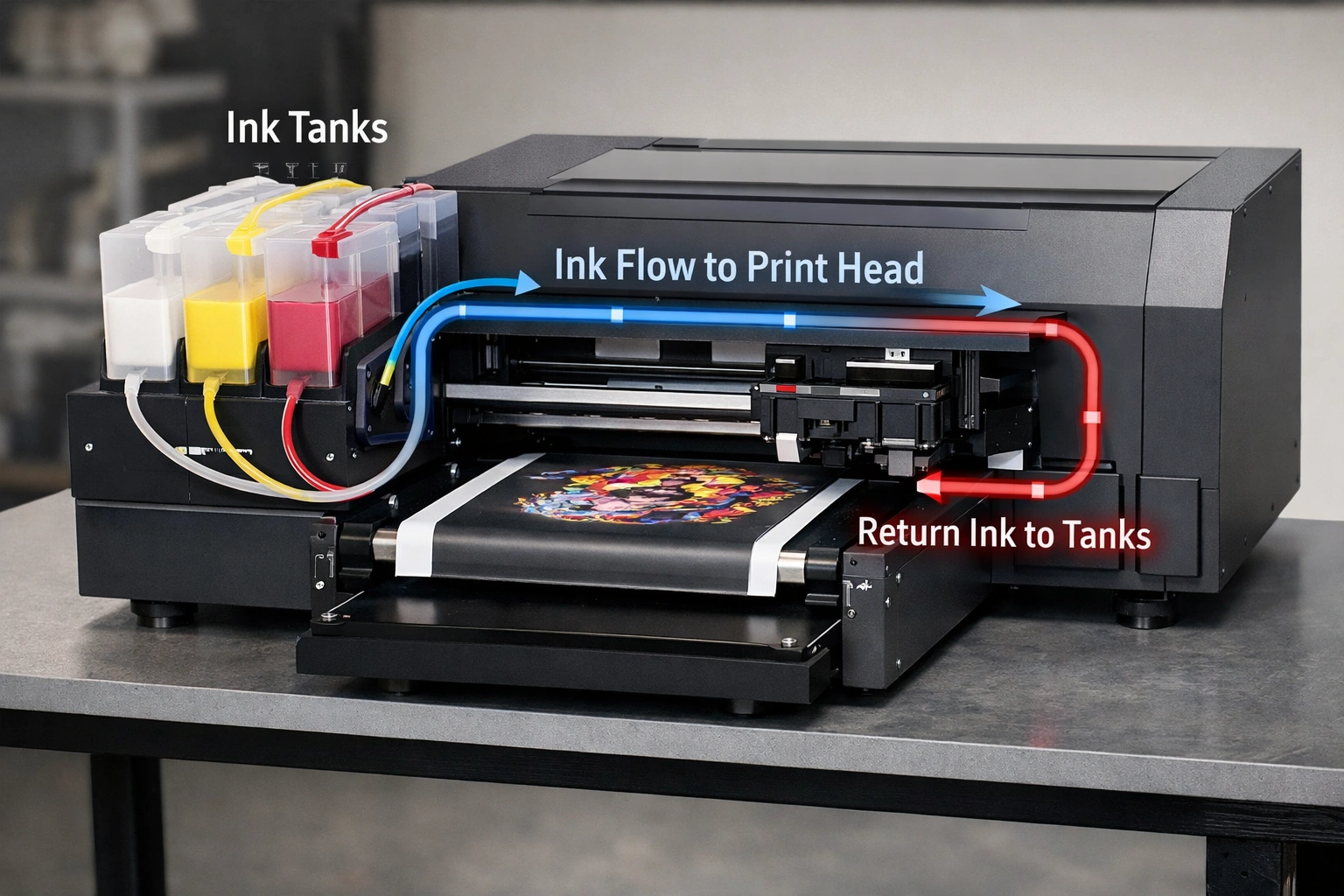
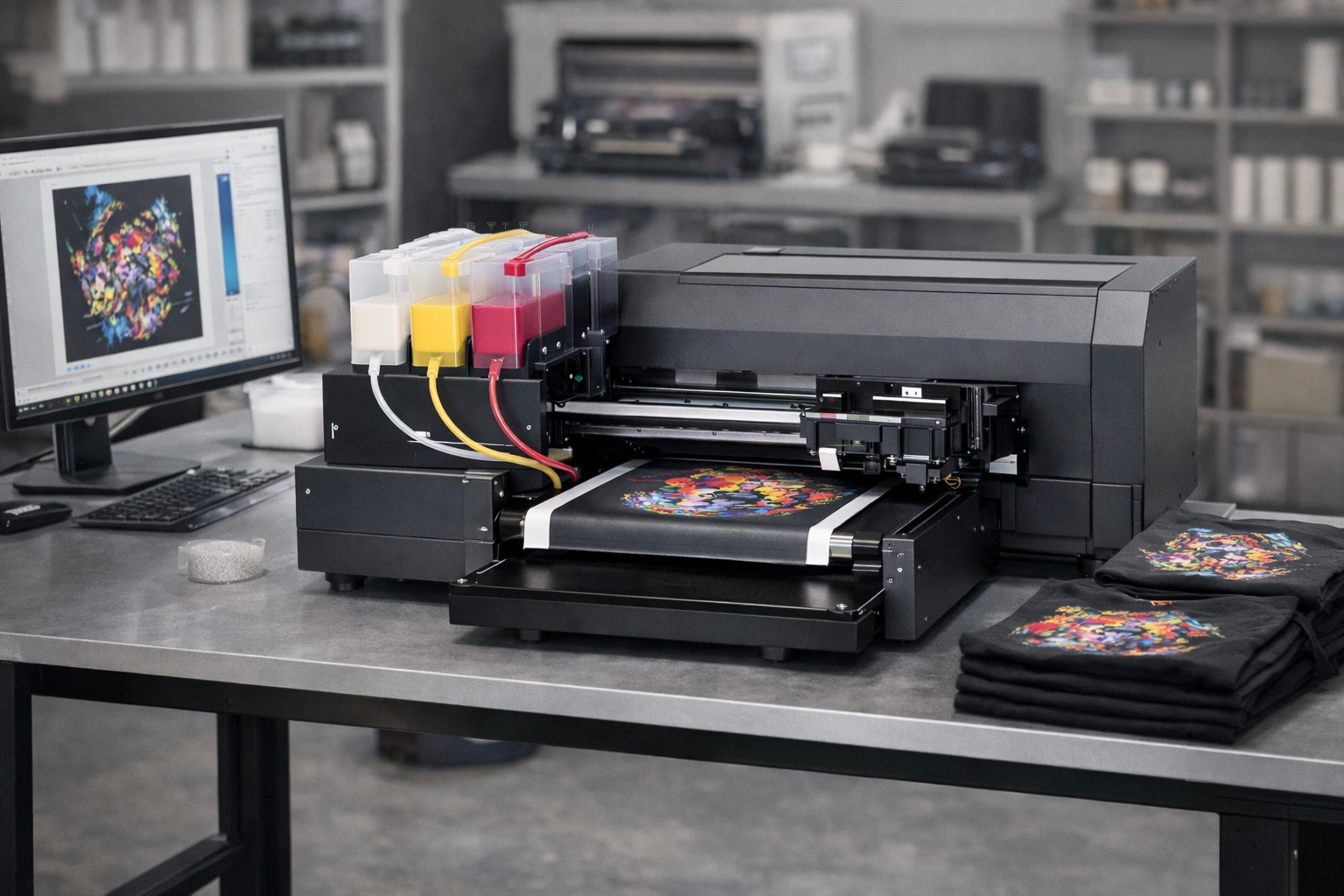
Direct to Film (DTF) printing has rapidly emerged as one of the most reliable and versatile digital textile printing technologies in the modern print industry. Its ability to deliver vibrant colors, fine details, and durable prints on a wide range of fabrics has made it a preferred choice for startups, small businesses, and industrial-scale operations alike. However, behind every high-quality DTF print lies a complex system working silently to maintain consistency, reliability, and efficiency—one of the most critical being the ink circulation system.
Ink circulation systems in DTF printers are not just auxiliary components; they are fundamental to printer health and output quality. Poor ink movement can result in nozzle clogging, color inconsistency, wasted ink, and costly downtime. To address these challenges, DTF printers generally rely on one of two ink circulation approaches: active ink circulation systems or passive ink circulation systems.
Understanding the difference between these two systems is essential for anyone involved in DTF printing—whether you are purchasing a new printer, upgrading an existing setup, or trying to improve production efficiency. This article provides a comprehensive, in-depth comparison of active and passive ink circulation systems, their working principles, advantages, limitations, and how to choose the right system for your business needs.
Understanding DTF Printing Technology
Before exploring ink circulation mechanisms, it is important to understand the basics of DTF printing itself.
DTF printing is a digital printing process in which designs are printed onto a specially coated PET film using water-based pigment inks. Once printed, an adhesive powder is applied to the wet ink, cured using heat, and then transferred onto fabric using a heat press. The result is a flexible, vibrant, and durable print that adheres well to cotton, polyester, blends, and even dark fabrics.
Unlike other textile printing methods, DTF printing does not require fabric pre-treatment and offers excellent color reproduction. However, this process heavily depends on the performance of the printer’s ink delivery system, especially because DTF inks often contain pigments that are prone to settling if not properly circulated.
Why Ink Circulation Matters in DTF Printers
Ink circulation systems are designed to keep ink moving continuously within the printer’s ink supply lines and print head assembly. This movement serves several crucial purposes:
Prevents pigment sedimentation
Maintains consistent ink viscosity
Reduces nozzle clogging
Ensures uniform color output
Extends print head lifespan
Improves overall machine reliability
DTF inks, particularly white ink, are known for having heavier pigment particles. Without effective circulation, these pigments can settle at the bottom of ink lines or cartridges, leading to blockages, uneven prints, and frequent maintenance requirements. This is why the choice between active and passive ink circulation systems plays such a vital role in long-term printer performance.
Types of Ink Circulation Systems in DTF Printing
DTF printers generally use one of the following two ink circulation methods:
Active Ink Circulation System
Passive Ink Circulation System
Each system has its own working principle, benefits, and trade-offs. Let’s explore them in detail.
Active Ink Circulation Systems
What Is an Active Ink Circulation System?
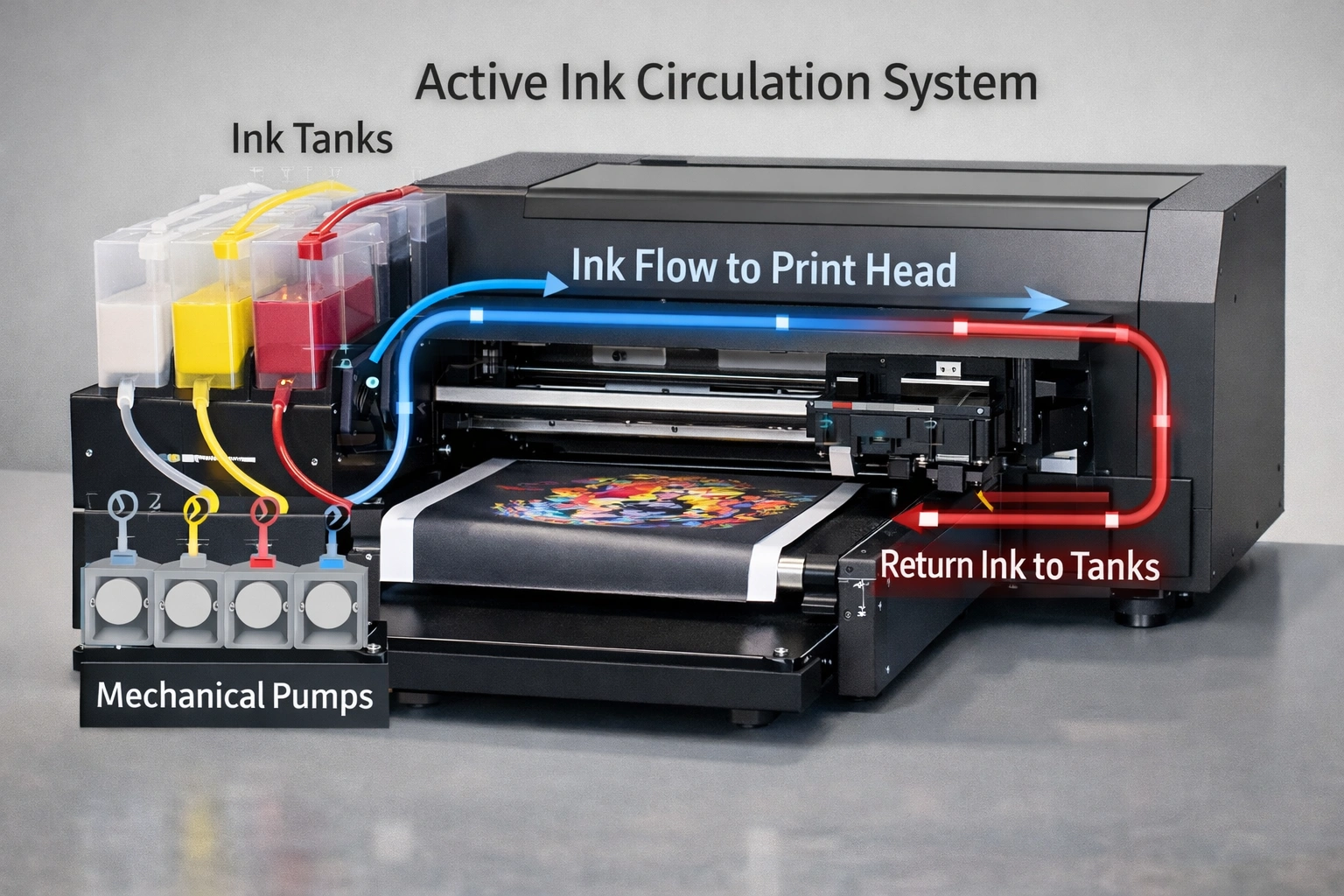
An active ink circulation system uses mechanical components—primarily pumps and motors—to move ink continuously through the ink lines, dampers, and print head channels. The system actively forces ink to circulate, ensuring that pigments remain evenly suspended and ink properties stay consistent.
This type of system is commonly found in professional, commercial, and industrial-grade DTF printers where print quality consistency and uptime are critical.
How Active Ink Circulation Works
In an active system:
Ink is drawn from the ink tank or cartridge using a pump.
The ink flows through the ink delivery lines toward the print head.
Excess ink is circulated back into the ink reservoir.
Sensors or software may regulate flow based on temperature or printing activity.
This constant motion prevents ink from becoming stagnant, even during idle periods.
Key Features of Active Ink Circulation Systems
Mechanical Pumps: Ensure continuous ink movement regardless of printer position.
Closed-Loop Circulation: Ink returns to the reservoir after passing through the system.
Temperature Stability: Circulation helps maintain uniform ink temperature.
Automated Control: Some systems adjust circulation intensity based on usage.
Advantages of Active Ink Circulation Systems
1. Superior Clog Prevention
Constant ink movement significantly reduces the chances of pigment settling, especially in white ink channels. This helps keep nozzles clean and functional.
2. Consistent Print Quality
Uniform ink viscosity and pigment distribution result in sharper details, smoother gradients, and accurate color reproduction.
3. Faster Startup Time
Since ink remains in circulation, printers with active systems require less priming time and are ready to print faster after idle periods.
4. Compatibility with Various Ink Types
Active systems can handle thicker or specialty inks that require continuous agitation to stay stable.
5. Improved Print Head Longevity
Reduced clogging and stable ink flow help extend the lifespan of expensive print heads.
Limitations of Active Ink Circulation Systems
Despite their advantages, active systems are not without drawbacks:
Higher Power Consumption: Pumps and motors require electricity, increasing energy usage.
Increased Noise Levels: Mechanical components can produce audible noise during operation.
Higher Initial Cost: Active systems add complexity and cost to the printer.
Maintenance Requirements: Pumps and moving parts may require periodic servicing or replacement.
Passive Ink Circulation Systems
What Is a Passive Ink Circulation System?
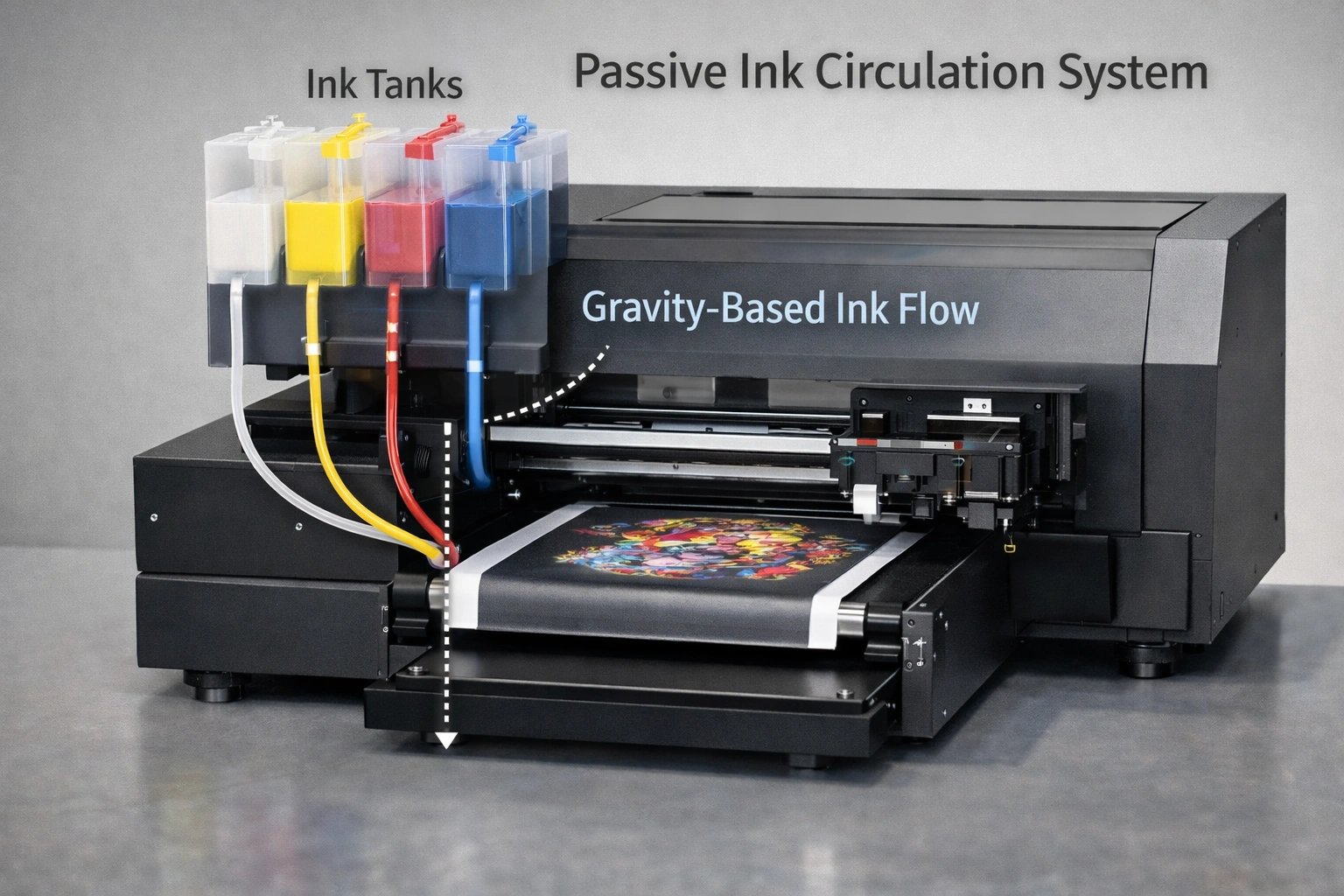
A passive ink circulation system relies on gravity, ink pressure, and system design rather than mechanical pumps to move ink toward the print head. Ink flow occurs naturally due to height differences between the ink reservoir and the print head.
These systems are commonly found in entry-level or budget-friendly DTF printers.
How Passive Ink Circulation Works
In a passive system:
Ink tanks are positioned above the print head.
Gravity pulls ink downward through ink lines.
Ink flows only when printing or during basic priming operations.
There is minimal or no return flow to the ink reservoir.
Key Features of Passive Ink Circulation Systems
Gravity-Based Ink Flow
Minimal Mechanical Components
Simple System Architecture
Low Energy Consumption
Advantages of Passive Ink Circulation Systems
1. Low Maintenance Requirements
With fewer mechanical parts, passive systems are easier to maintain and less prone to mechanical failure.
2. Quiet Operation
The absence of pumps results in near-silent operation, making these systems ideal for small studios or home-based businesses.
3. Energy Efficiency
Passive systems consume minimal power, reducing operational costs.
4. Lower Purchase Cost
Printers with passive circulation systems are generally more affordable upfront.
Limitations of Passive Ink Circulation Systems
Passive systems also have notable disadvantages:
Higher Risk of Ink Sedimentation
Without constant movement, pigments—especially white ink—can settle, leading to clogs.Slower Print Startup
Ink may take longer to reach the print head after idle periods.Limited Ink Compatibility
Thicker or pigment-heavy inks may not perform well.More Frequent Manual Maintenance
Users may need to agitate ink tanks manually or perform frequent cleaning cycles.
Active vs Passive Ink Circulation: A Practical Comparison
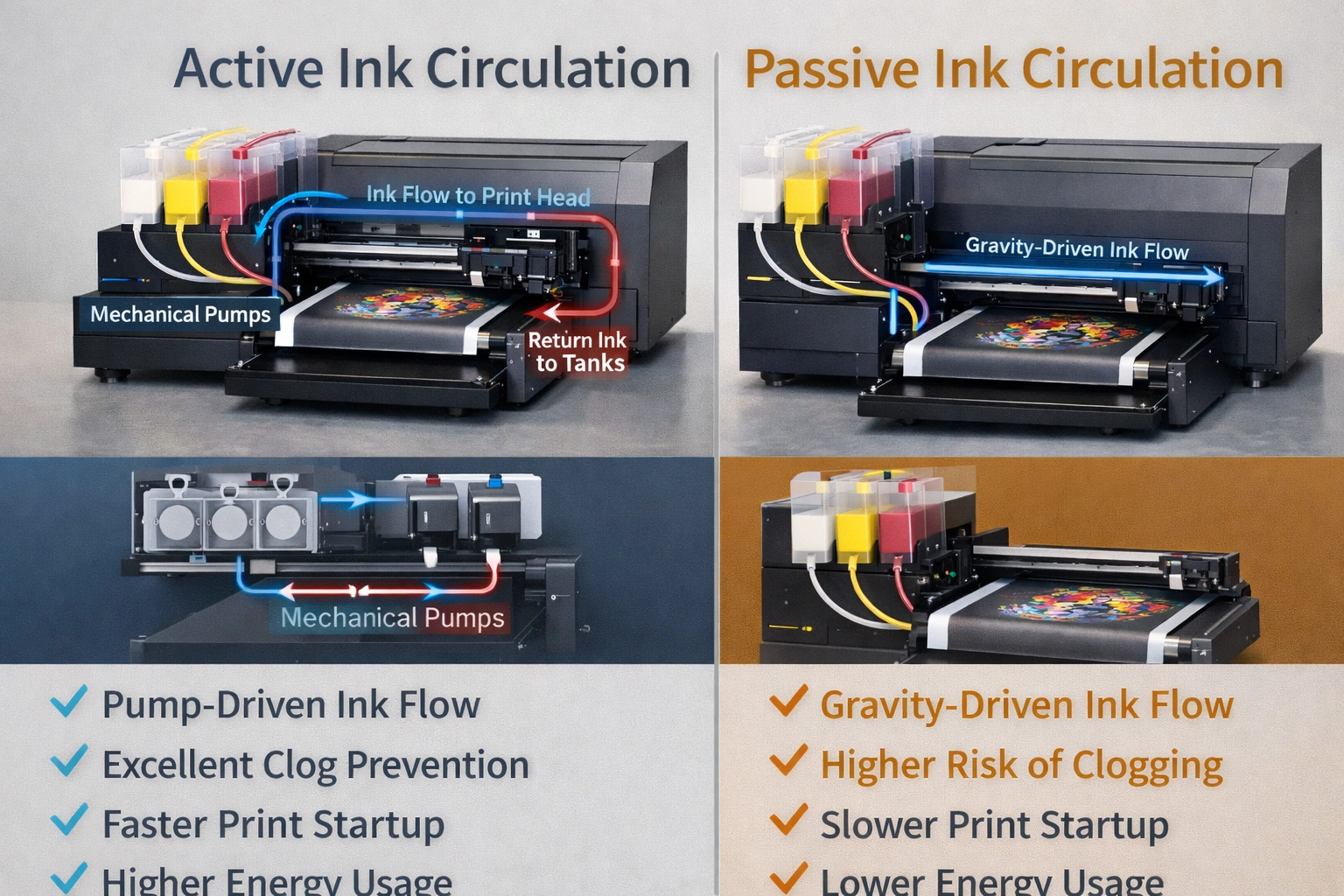
| Feature | Active System | Passive System |
|---|---|---|
| Ink Movement | Pump-driven | Gravity-based |
| Clog Prevention | Excellent | Moderate |
| Print Quality | Highly consistent | Can vary |
| Noise Level | Moderate | Very low |
| Energy Use | Higher | Lower |
| Maintenance | Moderate | Low |
| Cost | Higher | Lower |
| Best For | High-volume production | Small-scale printing |
How to Choose the Right Ink Circulation System
Selecting the right ink circulation system depends on your business requirements and operational priorities.
1. Production Volume
High-volume or commercial operations benefit from active systems due to reliability and speed.
2. Ink Type
If you frequently use white ink or specialty pigments, active circulation is strongly recommended.
3. Budget
Passive systems are suitable for startups with limited budgets, while active systems offer better long-term value for growing businesses.
4. Workspace Environment
Noise-sensitive environments may favor passive systems.
5. Maintenance Capability
If you want minimal hands-on maintenance, active systems can reduce manual intervention.
Future Trends in DTF Ink Circulation Technology
As DTF printing continues to evolve, manufacturers are developing hybrid solutions that combine elements of both active and passive circulation. These advanced systems aim to balance energy efficiency with consistent ink flow, offering smarter automation and improved reliability.
Emerging innovations include sensor-controlled circulation, automated ink agitation, and AI-driven maintenance alerts, all designed to further enhance print quality and reduce downtime.
Conclusion
Ink circulation systems play a decisive role in the performance, reliability, and print quality of DTF printers. While active ink circulation systems provide superior consistency, clog prevention, and productivity, passive ink circulation systems offer simplicity, affordability, and energy efficiency.
There is no one-size-fits-all solution. The best choice depends on your production volume, ink usage, budget, and long-term business goals. By understanding the strengths and limitations of both systems, you can make an informed decision that maximizes efficiency and ensures consistent, high-quality DTF printing results.Explore our high-quality DTF printers here
Frequently Asked Questions (FAQ)
What is the main purpose of ink circulation in DTF printers?
Ink circulation ensures consistent ink flow, prevents pigment settling, and reduces nozzle clogging.
Is active ink circulation necessary for white ink?
Yes, white ink benefits greatly from active circulation due to its heavy pigment content.
Are passive systems suitable for commercial printing?
They can be used for low to medium volumes but may struggle in continuous production environments.
Do active systems increase printer lifespan?
Yes, by reducing clogs and stabilizing ink flow, they help extend print head life.
Can passive systems be upgraded to active systems later?
In most cases, no. The circulation system is usually integrated into the printer design.