

 HOME
HOME PRODUCT CENTER
 ABOUT US
 DOWNLOAD CENTER
 SUPPORT CENTER
 SUBSCRIBE
 BLOG
BLOGAI-Driven Image Registration in Visual UV Printing
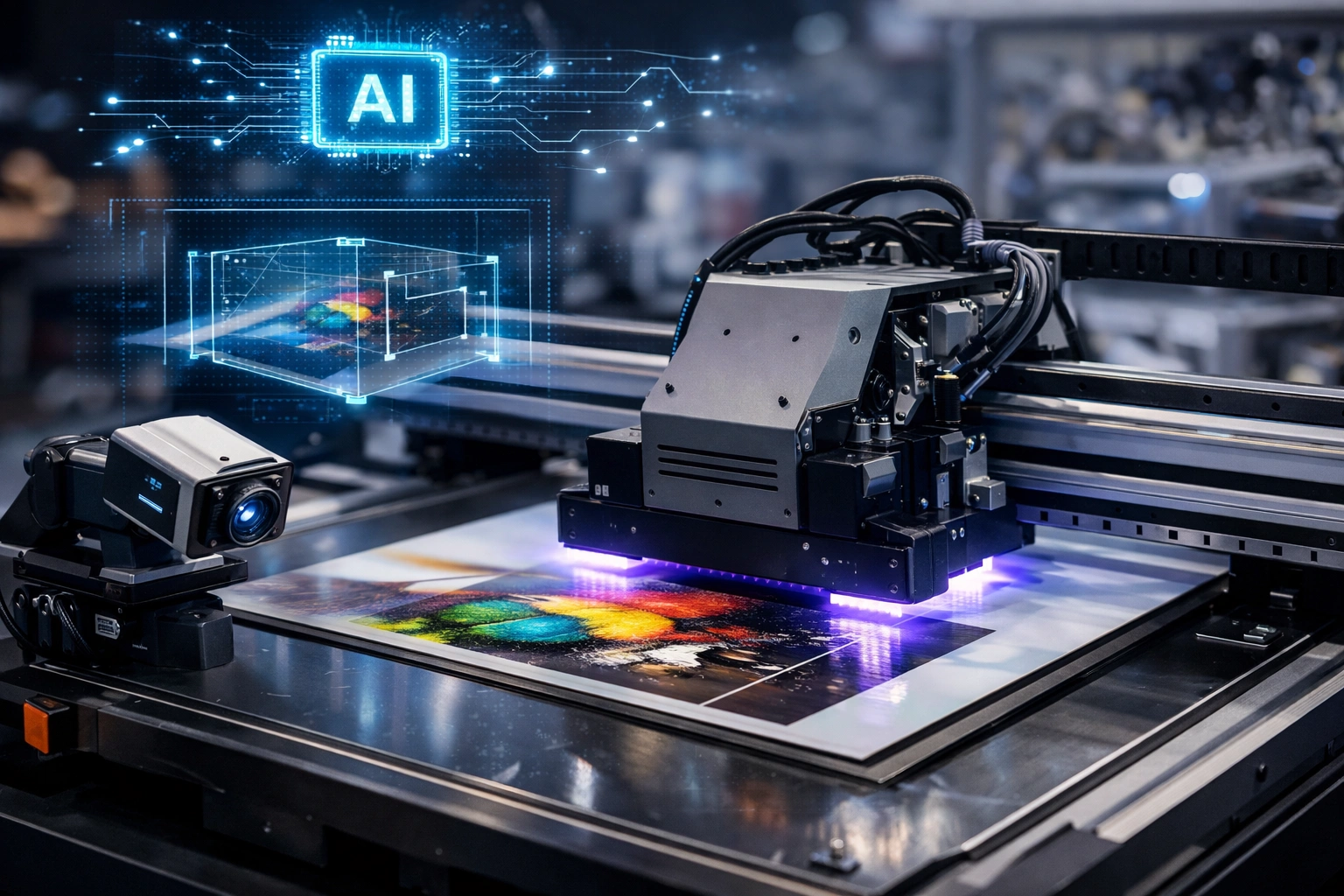
Precision has always been the backbone of high-quality digital printing. In industries where brand consistency, fine detail, and color accuracy matter, even the slightest misalignment can compromise the final output. Visual UV printing has emerged as a powerful solution for printing on rigid, irregular, and non-traditional substrates, but image registration remains one of its most critical technical challenges.
As printing speeds increase and substrates become more diverse, traditional registration methods struggle to maintain accuracy. This is where artificial intelligence is redefining the landscape. By combining computer vision, machine learning, and real-time data processing, AI enables visual UV printers to achieve a level of registration accuracy that was previously difficult or impossible.
This article explores how AI enhances image registration in visual UV printers, explains the underlying technology, outlines the business benefits, examines implementation challenges, and looks ahead to the future of AI-powered UV printing.
What Is Image Registration in Visual UV Printing?
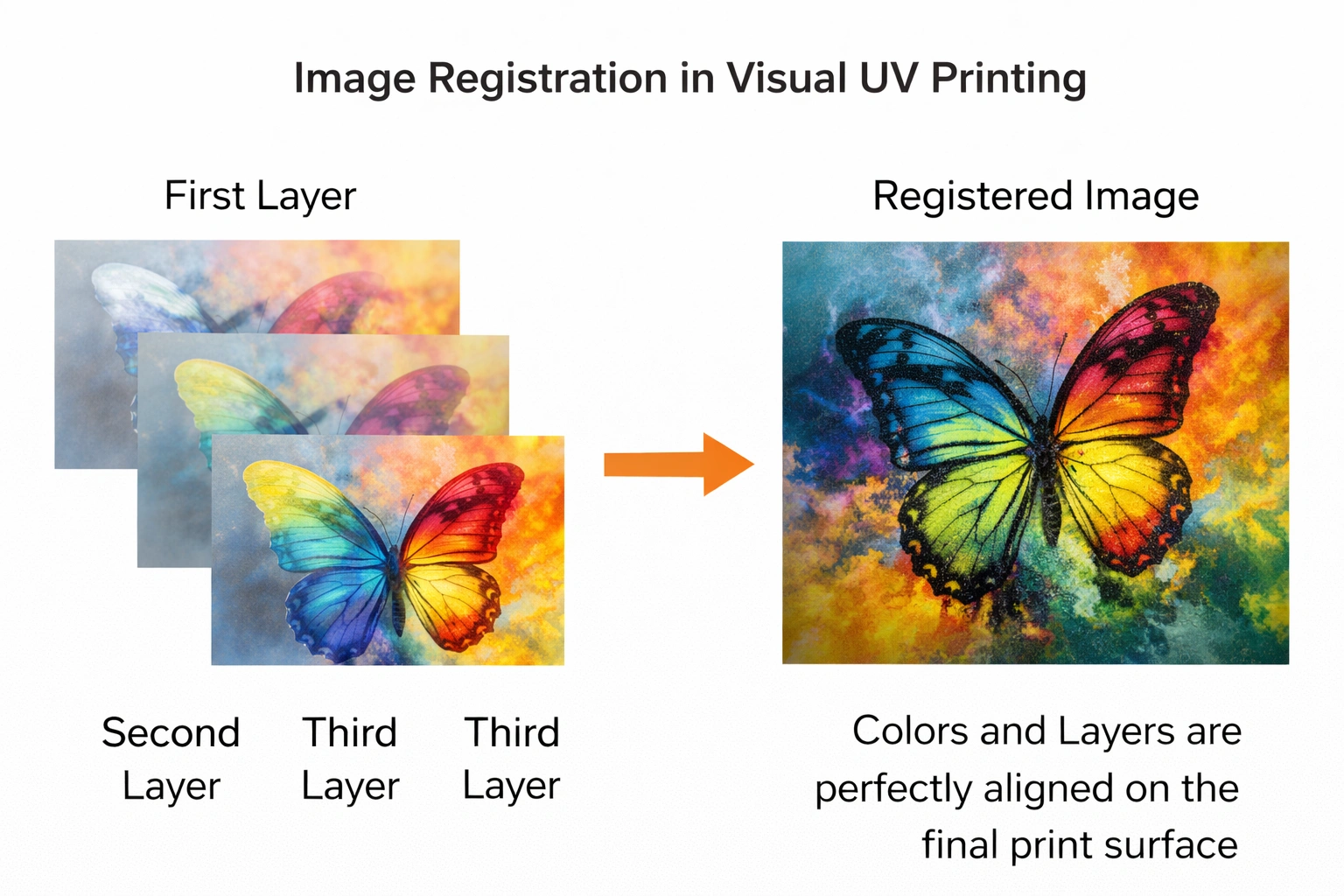
Image registration refers to the precise alignment of multiple image elements—such as colors, layers, and passes—during the printing process. In visual UV printing, registration accuracy is especially important because the printer often works with rigid or uneven surfaces rather than flat, uniform media.
Unlike conventional printing, visual UV printers frequently print on objects such as glass, metal, wood, acrylic, leather, plastic, ceramics, and shaped industrial components. These substrates may vary in thickness, texture, reflectivity, and position, making accurate alignment more complex.
Image registration in visual UV printing involves:
Aligning ink layers across multiple passes
Matching printed graphics to physical object contours
Maintaining color-to-color precision
Ensuring consistent placement across repeated prints
Any deviation can lead to blurred edges, ghosting, color overlap, or incomplete coverage, which directly affects print quality and customer satisfaction.
Why Accurate Image Registration Matters
Print Quality and Visual Clarity
High-resolution UV printing depends on precise alignment of ink droplets. When registration is off, even slightly, fine text becomes unreadable, gradients appear uneven, and edges lose sharpness. AI-driven registration ensures that every layer lands exactly where it should, preserving visual clarity.
Material Efficiency and Waste Reduction
Misregistration often results in rejected prints. In UV printing, this waste can be costly due to expensive inks and substrates. Accurate registration significantly reduces scrap rates, saving both materials and operational costs.
Production Speed and Workflow Stability
Manual alignment and frequent recalibration slow down production. AI-enabled systems reduce setup time and minimize interruptions, allowing continuous, high-speed printing without compromising accuracy.
Brand Consistency
For businesses producing branded items, packaging, or promotional products, consistency is non-negotiable. AI-powered registration ensures uniform results across batches, shifts, and locations.
Limitations of Traditional Registration Methods
Before AI integration, image registration relied heavily on mechanical alignment, fixed reference points, and operator intervention. While effective in controlled environments, these methods have clear limitations.
Static Reference Systems
Traditional systems depend on pre-defined markers or fixed coordinates. If a substrate shifts slightly or varies in shape, the system struggles to compensate.
Manual Calibration
Operators often need to adjust alignment manually, especially when changing substrates or designs. This increases setup time and introduces the possibility of human error.
Limited Adaptability
Conventional registration systems lack the ability to learn from previous prints. Each job is treated independently, without leveraging historical data to improve accuracy.
Reduced Accuracy at High Speeds
As printing speeds increase, mechanical systems struggle to maintain precision, leading to misalignment during long or complex print runs.
How AI Enhances Image Registration in Visual UV Printers
Artificial intelligence transforms image registration from a static process into a dynamic, self-correcting system. Below are the key ways AI improves accuracy and efficiency.
Computer Vision for Intelligent Surface Detection
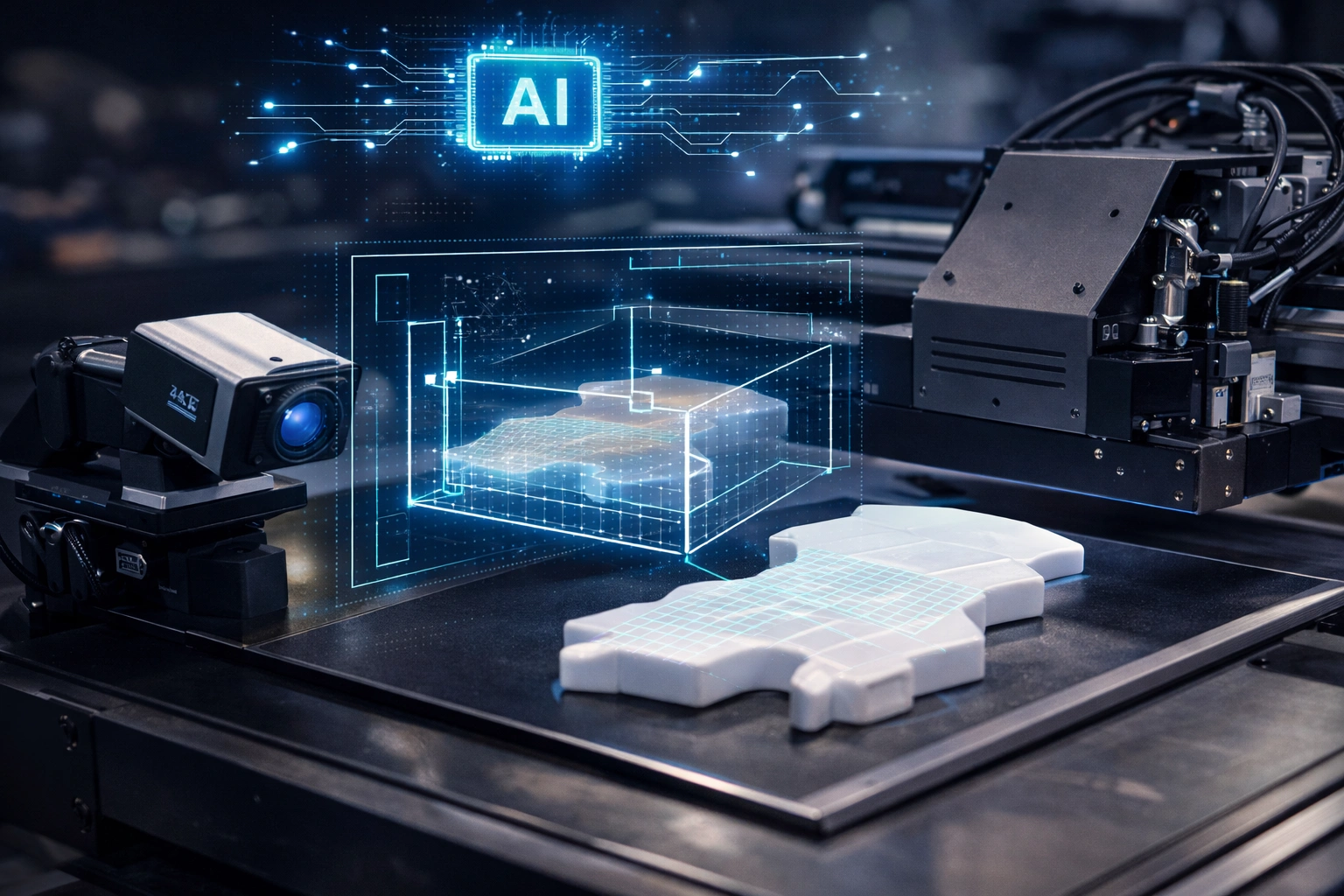
AI-powered computer vision allows visual UV printers to “see” the substrate before and during printing.
Surface Recognition
Using high-resolution cameras, AI analyzes the surface texture, edges, contours, and reflective properties of the object. This enables the printer to understand the exact shape and position of the substrate.
Automatic Position Mapping
Instead of relying on fixed coordinates, AI dynamically maps the object’s real-world position. Even if the item is slightly rotated or offset, the system adjusts automatically.
Multi-Object Detection
AI can identify multiple objects on the print bed simultaneously, ensuring accurate registration for batch printing without manual intervention.
Automated Alignment Without Manual Input
One of the biggest advantages of AI-driven registration is automation.
Feature-Based Alignment
AI identifies key visual features—such as corners, holes, edges, or patterns—and uses them as alignment references. This removes the need for physical markers or templates.
Zero-Touch Setup
Once the design is loaded, the system aligns it automatically to the detected substrate. Operators no longer need to fine-tune alignment manually.
Faster Job Changeovers
Switching between different products or designs becomes faster, improving overall equipment efficiency.
Real-Time Registration Corrections During Printing
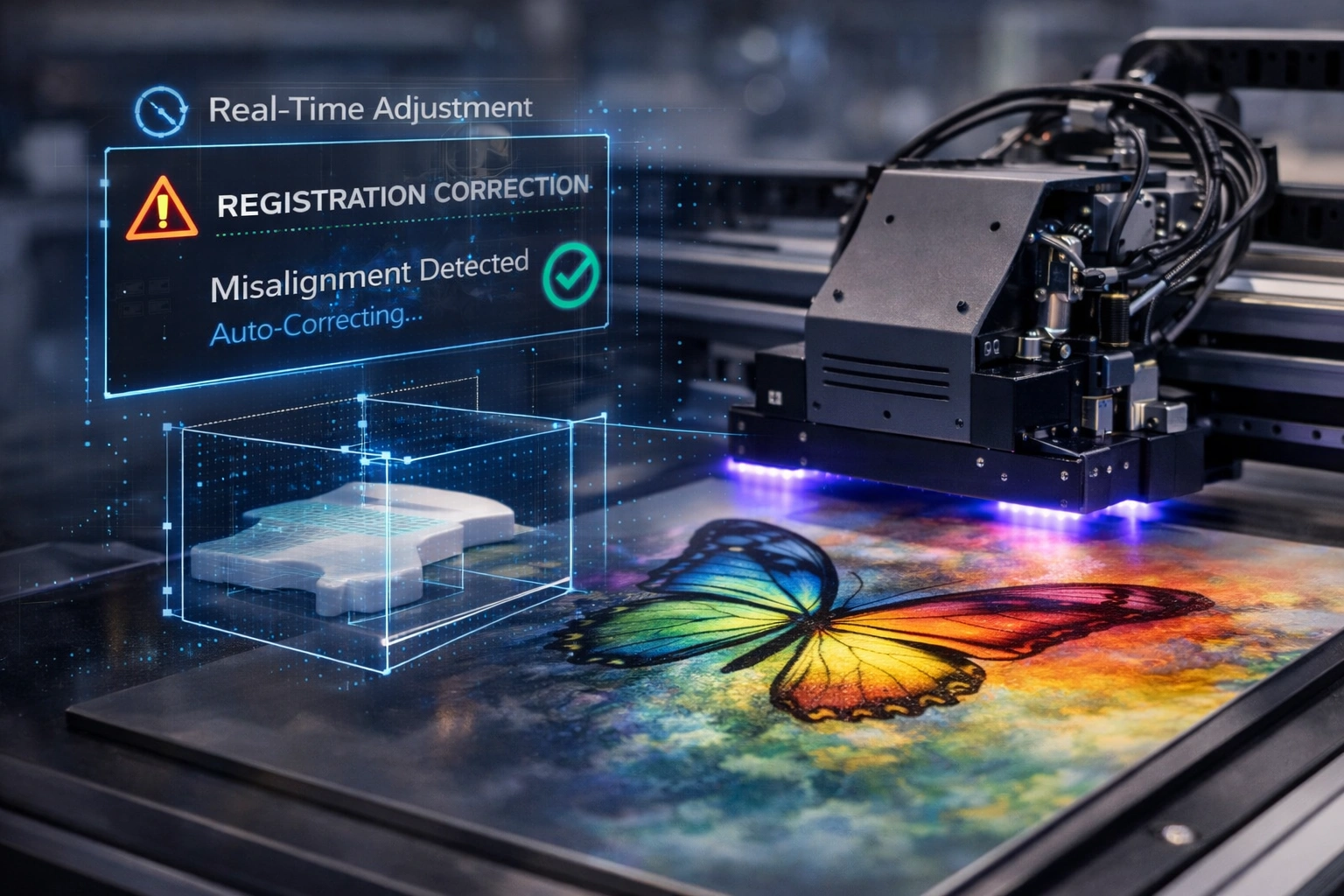
AI does not stop working once printing begins. It continuously monitors the process.
Live Error Detection
Computer vision systems detect even minor deviations in ink placement as they occur. This allows the printer to correct errors mid-print.
Dynamic Compensation
If the substrate shifts slightly due to vibration, temperature, or mechanical movement, AI compensates instantly by adjusting print head positioning.
Reduced Downtime
Because corrections happen in real time, there is no need to stop production for recalibration, keeping workflows smooth and uninterrupted.
Predictive Analytics for Registration Stability
AI excels at learning from data, and this capability plays a major role in long-term registration accuracy.
Historical Data Analysis
AI analyzes data from previous print jobs, including alignment errors, substrate behavior, and environmental conditions.
Error Prediction
By identifying patterns, the system can predict when and where misregistration is likely to occur and take preventive action.
Process Optimization
Predictive insights help operators fine-tune print settings, ink flow, and curing parameters to maintain consistent alignment.
AI-Enhanced Image Preprocessing
Image registration begins before printing even starts.
Edge Enhancement
AI improves edge detection in digital files, making it easier for the system to align graphics precisely with physical objects.
Color Layer Optimization
Machine learning algorithms analyze color layers to ensure proper overlap and sequencing, reducing the risk of misalignment between colors.
Adaptive Scaling
AI adjusts image scaling based on substrate size and shape, ensuring perfect fit without distortion.
Self-Learning and Continuous Improvement
One of AI’s most powerful features is adaptive learning.
Performance Feedback Loops
Each print job generates data that feeds back into the system. AI uses this information to refine its algorithms.
Continuous Accuracy Improvement
Over time, the printer becomes more accurate as it learns how different materials behave under various conditions.
Reduced Dependence on Skilled Operators
As the system improves itself, the need for constant human supervision decreases, lowering training costs and operational complexity.
Business Benefits of AI-Powered Image Registration
Higher Productivity
Automation, real-time correction, and faster setup times significantly increase throughput without sacrificing quality.
Lower Operational Costs
Reduced waste, fewer reprints, and less downtime translate directly into cost savings.
Superior Print Quality
Sharper details, accurate colors, and consistent placement enhance the perceived value of printed products.
Scalability
AI-driven systems make it easier to scale production without a proportional increase in labor or error rates.
Competitive Advantage
Businesses that adopt AI-enhanced UV printing can offer faster turnaround times, better quality, and more customization options.
Challenges of Implementing AI in Visual UV Printing
While the benefits are substantial, there are challenges to consider.
Initial Investment
AI-enabled visual UV printers typically require a higher upfront cost. However, the long-term savings often justify the investment.
Integration Complexity
Implementing AI may require updates to software, hardware, and workflows. Proper planning is essential to avoid disruptions.
Skill Requirements
Although AI reduces manual intervention, companies still need trained personnel to manage and maintain advanced systems.
Data Management and Security
AI systems rely on large volumes of data. Ensuring data security and regulatory compliance is critical.
Best Practices for Successful AI Adoption
Start with clear production goals and quality benchmarks
Train operators to work alongside AI systems
Regularly update software and firmware
Monitor performance metrics to measure ROI
Partner with experienced equipment providers
The Future of AI in Visual UV Image Registration
AI technology is evolving rapidly, and its role in visual UV printing will continue to expand.
Smarter Vision Systems
Future systems will offer even higher resolution and faster processing, enabling near-perfect registration on complex objects.
Deeper Machine Learning Integration
Printers will become increasingly autonomous, capable of optimizing entire workflows without human input.
Greater Accessibility
As AI technology becomes more affordable, small and mid-sized print shops will gain access to advanced registration capabilities.
Industry-Wide Standardization
AI-driven registration is likely to become the standard rather than a premium feature, reshaping expectations across the printing industry.

Conclusion
Artificial intelligence has fundamentally changed how image registration is handled in visual UV printing. By replacing static, manual processes with intelligent, adaptive systems, AI delivers unprecedented accuracy, efficiency, and consistency.
From automated alignment and real-time correction to predictive analytics and self-learning algorithms, AI empowers visual UV printers to perform at a level that meets the demands of modern production environments. While implementation requires thoughtful planning and investment, the long-term benefits far outweigh the challenges.explore our high-quality Visual Positioning UV printers here.
As AI technology continues to advance, businesses that embrace AI-driven image registration will be better positioned to deliver superior print quality, reduce costs, and stay competitive in an increasingly demanding market.
Frequently Asked Questions (FAQ)
What is image registration in visual UV printing?
Image registration is the process of accurately aligning printed graphics with the substrate, ensuring precise placement of colors and layers.
Why is AI important for image registration?
AI enables real-time adjustments, predictive error prevention, and automated alignment, significantly improving accuracy and efficiency.
Does AI reduce manual intervention?
Yes, AI minimizes the need for manual calibration and alignment, allowing operators to focus on higher-value tasks.
Is AI suitable for small print businesses?
As AI technology becomes more accessible, it is increasingly suitable for small and mid-sized operations seeking higher quality and efficiency.
Can AI handle irregular or curved surfaces?
Yes, AI-powered computer vision excels at detecting contours and adapting prints to non-flat surfaces.