

 HOME
HOME PRODUCT CENTER
 ABOUT US
 DOWNLOAD CENTER
 SUPPORT CENTER
 SUBSCRIBE
 BLOG
BLOGOptical vs Visual Registration in UV Printing
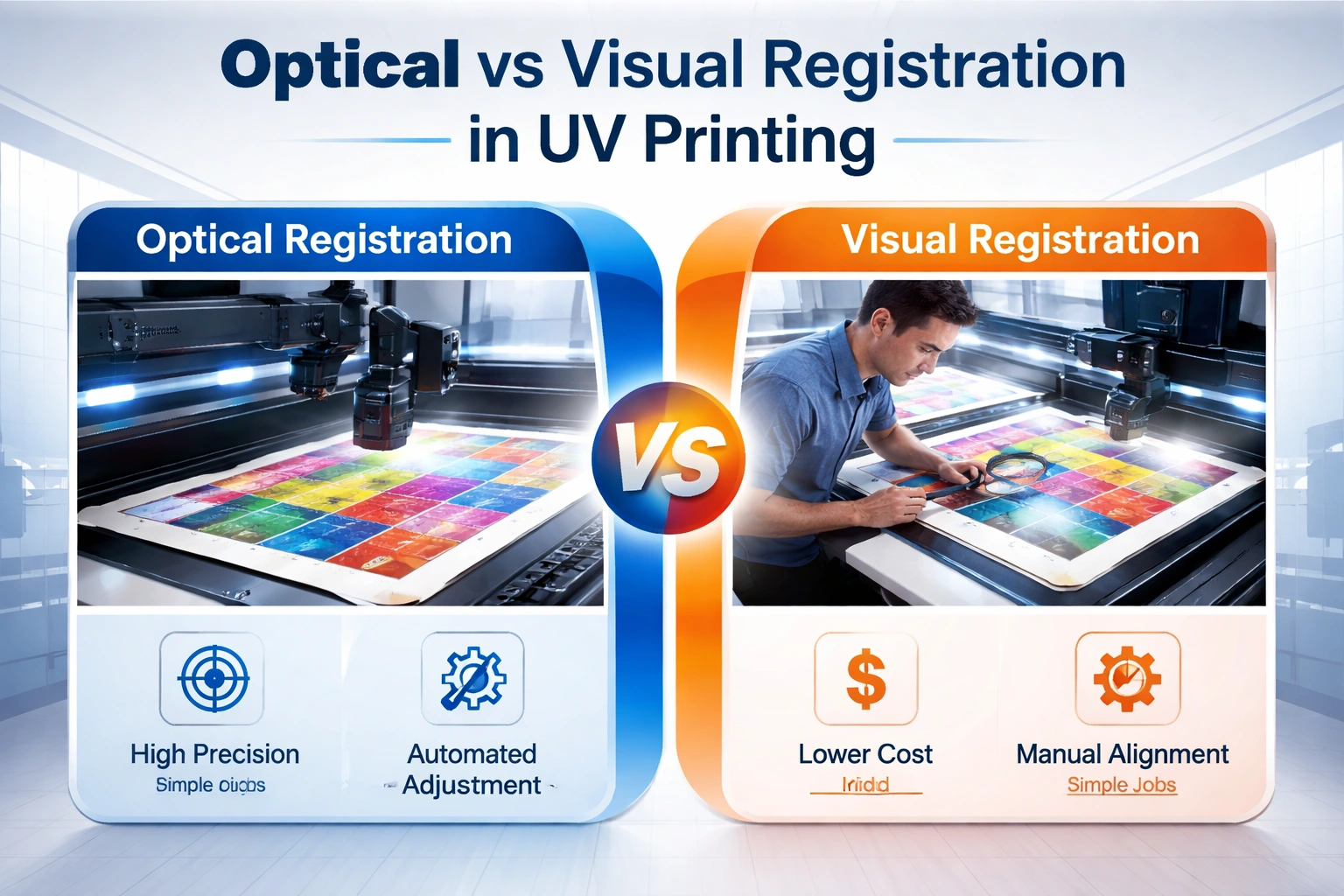
In modern UV printing, precision is no longer a luxury—it is a necessity. As printing applications expand into packaging, signage, industrial decoration, and customized products, the demand for accurate alignment has grown significantly. Registration, which refers to the precise positioning of printed elements on a substrate, directly influences print quality, consistency, and overall production efficiency.
Among the various registration approaches used in UV printing, optical registration and visual registration are the two most widely adopted methods. Each method serves a different operational need, production scale, and budget level. While optical registration relies on advanced camera systems and automated alignment, visual registration depends largely on human observation and manual adjustments.
This article provides a detailed, practical, and unbiased comparison of optical and visual registration methods in UV printing. It explores how each system works, their advantages and limitations, cost implications, performance in real-world scenarios, and guidance on selecting the right approach for different business needs. The goal is to help print professionals make informed decisions that improve output quality while maintaining operational efficiency.
The Importance of Registration in UV Printing
Registration accuracy is one of the most critical quality factors in UV printing. Poor registration can lead to overlapping errors, color misalignment, blurred edges, and rejected prints. These issues not only waste materials but also increase production time and costs.
UV printing often involves multi-layer printing, white ink layers, varnish effects, or printing on pre-shaped or irregular substrates. In such cases, even a minor misalignment can ruin the final product. Therefore, selecting the right registration method is essential for achieving consistent results, especially in competitive commercial printing environments.
Understanding Optical Registration
What Is Optical Registration?
Optical registration is a technology-driven alignment method that uses cameras, sensors, and image-processing software to automatically detect reference points on a substrate. These reference points can be printed markers, edges, contours, or predefined patterns.
During the printing process, the system captures real-time images of the substrate and compares them with the digital print file. Based on this comparison, the printer automatically adjusts the print head position to ensure precise alignment before ink is deposited.
This process occurs continuously and does not rely on human judgment, making optical registration highly accurate and repeatable.
How Optical Registration Works
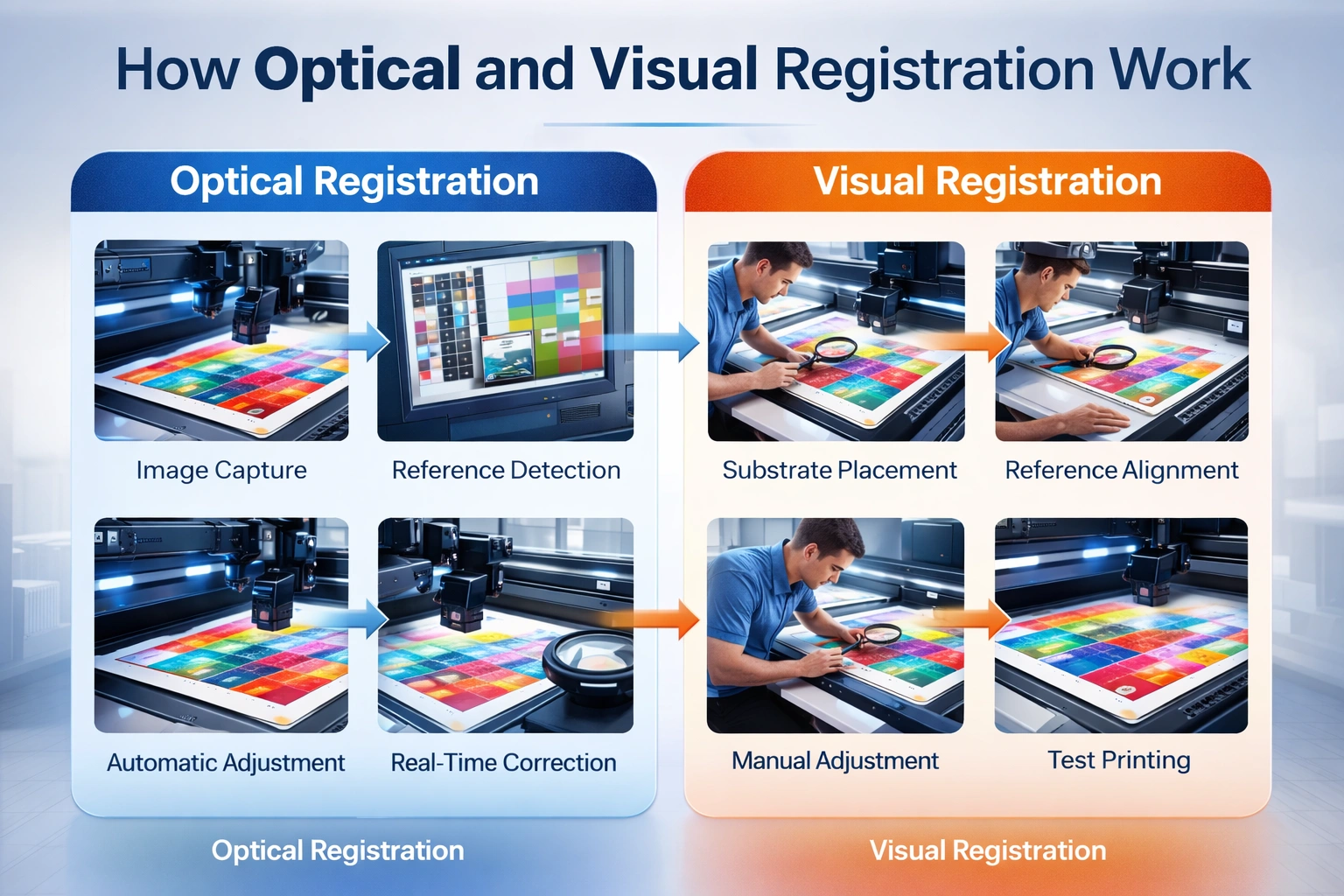
Image Capture
High-resolution cameras scan the substrate surface before printing.Reference Detection
The system identifies registration marks, shapes, or edges.Data Comparison
Captured images are matched against the digital design file.Automatic Adjustment
The printer software recalculates positioning and aligns the print head accordingly.Real-Time Correction
Adjustments are applied instantly, even if the substrate shifts slightly.
Advantages of Optical Registration
High Precision and Accuracy
Optical registration offers exceptional alignment accuracy, often within fractions of a millimeter. This level of precision is difficult to achieve consistently through manual methods.
Real-Time Error Correction
Because the system continuously monitors alignment, it can compensate for substrate movement, stretching, or placement variation during printing.
Automation and Consistency
Once configured, optical registration minimizes operator involvement, delivering uniform results across large production runs.
Ideal for Complex Designs
Jobs involving multilayer printing, fine text, gradients, embossing effects, or variable data benefit significantly from optical alignment.
Reduced Material Waste
Accurate alignment reduces misprints and rework, lowering ink and substrate waste over time.
Limitations of Optical Registration
Higher Initial Investment
Optical registration systems require advanced hardware and software, increasing upfront costs.
Technical Setup and Calibration
Initial setup, calibration, and maintenance require trained personnel.
Sensitivity to Environment
Dust, lighting variations, or reflective surfaces can sometimes affect camera detection if not properly managed.
Understanding Visual Registration
What Is Visual Registration?
Visual registration is a manual alignment method where the printer operator aligns the substrate using visual guides, rulers, printed markers, or templates. The alignment is done before printing begins, based on the operator’s experience and judgment.
This method does not rely on cameras or automated detection. Instead, accuracy depends on careful placement and operator skill.
How Visual Registration Works
Substrate Placement
The operator manually positions the material on the printer bed.Reference Alignment
Alignment is done using printed guides, grids, or physical stops.Manual Adjustment
The operator adjusts placement until the alignment appears correct.Test Printing
Often requires trial prints to verify accuracy.
Advantages of Visual Registration
Lower Equipment Cost
Visual registration does not require advanced sensors or cameras, making it affordable for small businesses.
Simple Technology
Minimal technical complexity makes it easy to learn and maintain.
Flexible for Short Runs
Ideal for one-off jobs, prototypes, or low-volume custom printing.
Quick Setup for Simple Jobs
For straightforward designs, visual registration can be faster to set up.
Limitations of Visual Registration
Inconsistent Accuracy
Results vary depending on operator skill and attention to detail.
Higher Risk of Human Error
Manual alignment increases the chances of misplacement or variation between prints.
Time-Consuming for Complex Jobs
Multiple test prints may be required to achieve acceptable alignment.
Limited Scalability
Not suitable for high-volume or precision-demanding production.
Optical vs Visual Registration: A Detailed Comparison
Precision and Reliability
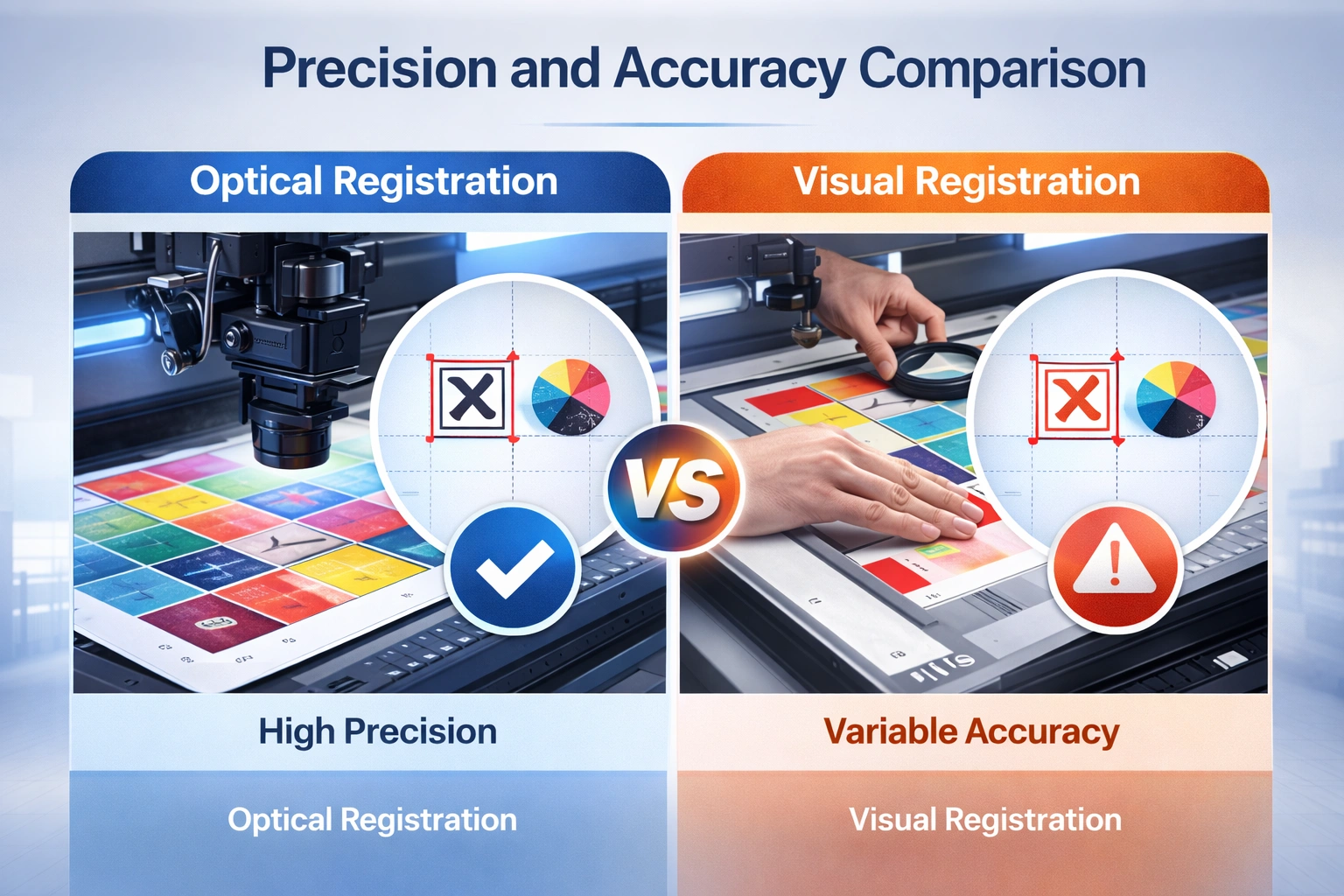
Optical registration consistently outperforms visual registration in terms of precision. Automated detection eliminates subjective judgment, ensuring repeatable accuracy across thousands of prints.
Visual registration can be accurate in skilled hands but lacks consistency, especially over long production runs.
Production Speed and Efficiency
Optical systems significantly reduce setup time once configured. Automated alignment accelerates workflow and minimizes reprints.
Visual registration often slows production due to manual setup and frequent checks.
Cost Over Time
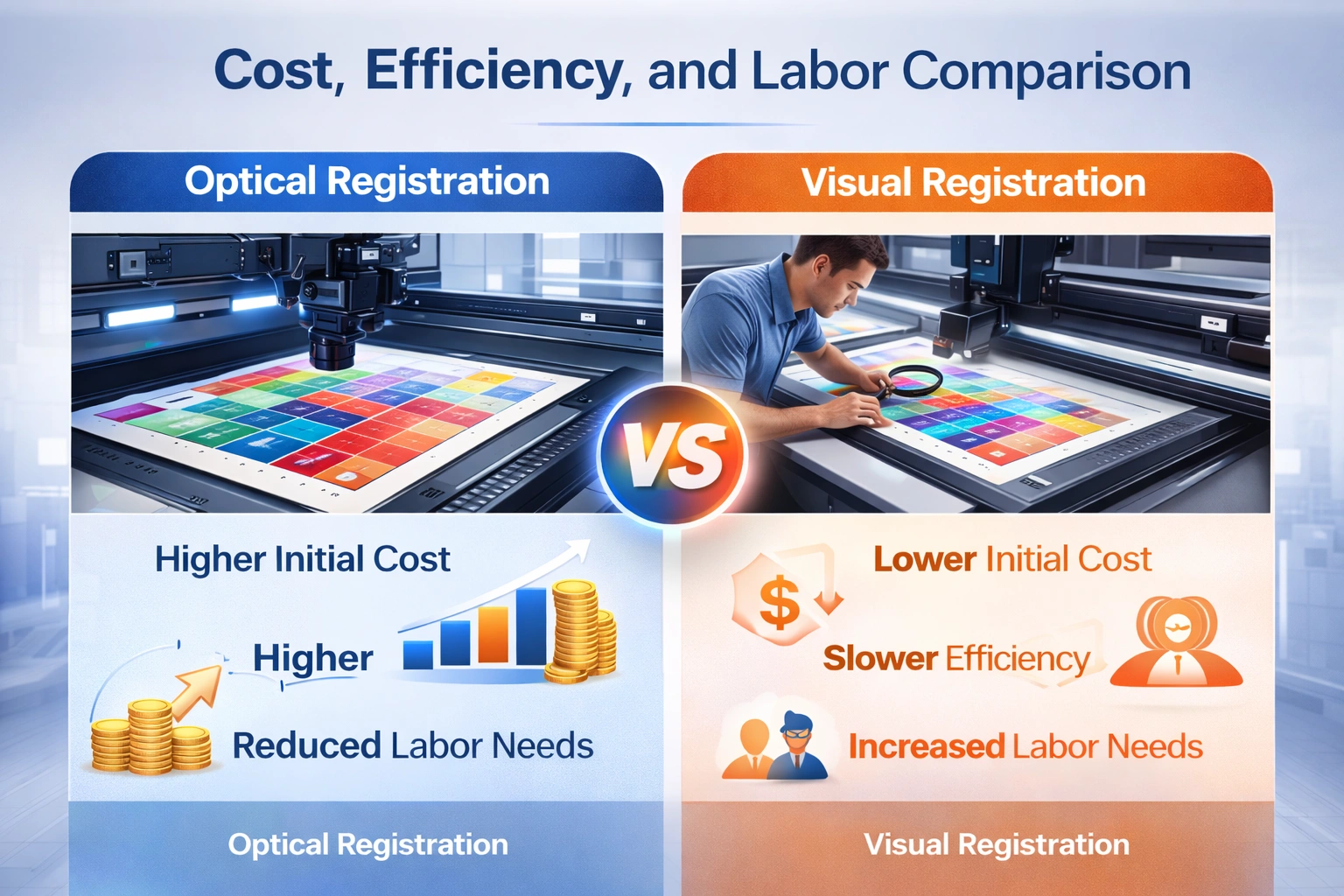
While optical registration has higher upfront costs, it often results in lower long-term expenses due to reduced waste, fewer errors, and higher productivity.
Visual registration may appear cost-effective initially but can become expensive over time due to inefficiencies and material loss.
Operator Dependency
Optical registration reduces reliance on operator expertise, making production less vulnerable to staffing changes.
Visual registration heavily depends on experienced operators, making consistency harder to maintain.
Suitability for Advanced Applications
Optical registration excels in applications such as:
Multi-layer printing
White ink alignment
Varnish and texture effects
Printing on irregular shapes
Visual registration is better suited for:
Flat substrates
Simple graphics
Small batch production
Choosing the Right Registration Method
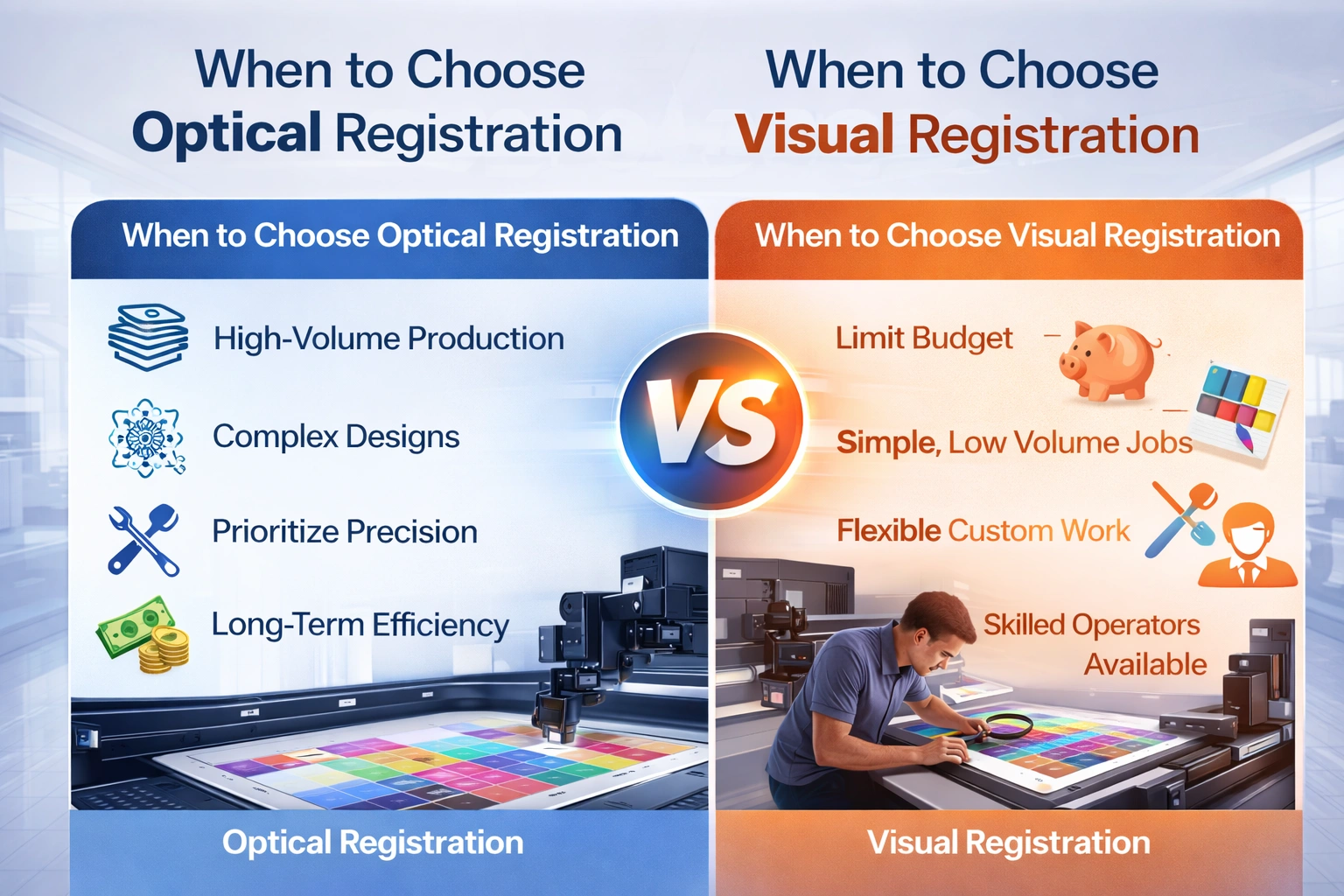
When Optical Registration Is the Better Choice
Optical registration is ideal if:
You handle high-volume production
Precision is critical
Designs are complex or multilayered
You want consistent quality with minimal manual intervention
Long-term efficiency is a priority
When Visual Registration Makes Sense
Visual registration is suitable if:
You operate on a limited budget
Jobs are simple and low volume
You need flexibility for custom work
Skilled operators are available
Hybrid Approaches in Modern UV Printing
Many modern UV printers combine both optical and visual registration methods. Operators may use visual alignment for rough placement and optical systems for final precision.
This hybrid approach offers flexibility while maintaining high-quality output, especially for diverse production environments.
Maintenance and Training Considerations
Optical Registration
Requires regular camera calibration
Software updates may be necessary
Operators need technical training
Preventive maintenance ensures long-term accuracy
Visual Registration
Minimal maintenance
Relies on operator skill development
Consistency improves with experience rather than technology
Future Trends in Registration Technology
The future of UV printing registration is moving toward increased automation and artificial intelligence. Emerging systems are becoming more adaptive, capable of learning from previous jobs and improving alignment accuracy automatically.
As technology becomes more accessible, optical registration is expected to become standard even for mid-sized printing businesses.
Conclusion
Both optical and visual registration methods play important roles in UV printing, but they serve different operational needs. Optical registration delivers unmatched precision, automation, and consistency, making it ideal for high-end and large-scale production. Visual registration, on the other hand, offers affordability and simplicity, making it suitable for smaller operations and basic printing tasks.
Choosing the right method depends on production volume, design complexity, budget, and long-term business goals. Understanding the strengths and limitations of each approach allows print businesses to optimize quality, efficiency, and profitability in an increasingly competitive market.
Want to explore robust solutions for your printing needs? Explore our high-quality Visual Positioning UV printers here.
Frequently Asked Questions (FAQ)
What is the biggest advantage of optical registration?
Its ability to provide highly accurate, automated alignment with minimal human intervention.
Is visual registration still relevant today?
Yes, especially for small-scale operations and simple printing tasks.
Can a printer upgrade from visual to optical registration?
In many cases, yes, depending on hardware compatibility and software support.
Which method is better for multi-layer UV printing?
Optical registration is significantly better for multilayer and precision-critical applications.