

 HOME
HOME PRODUCT CENTER
 ABOUT US
 DOWNLOAD CENTER
 SUPPORT CENTER
 SUBSCRIBE
 BLOG
BLOGCustom Firmware for Visual Positioning UV Printers
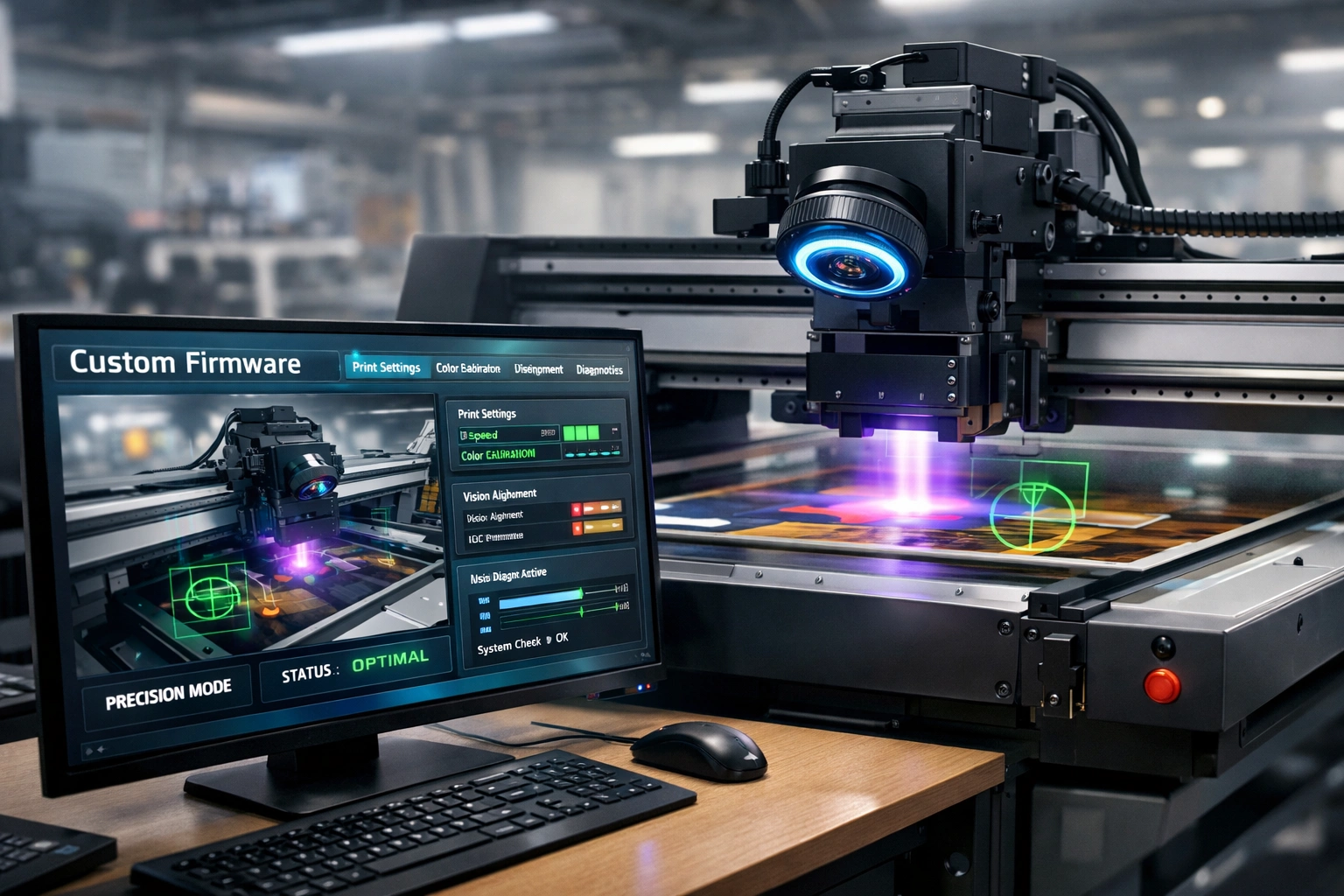
The digital printing industry is undergoing rapid transformation as manufacturers and print service providers demand higher precision, faster output, and greater automation. Among the most advanced solutions available today are Visual Positioning UV printers, which combine UV curing technology with intelligent camera-based alignment systems. These machines are widely used in applications such as signage, packaging, industrial labeling, decorative printing, and customized manufacturing.
While hardware innovation has significantly improved print accuracy and speed, the true performance of a Visual Positioning UV printer is largely determined by its firmware. Standard, factory-installed firmware is designed to serve a broad range of users and applications. However, such generalized software often fails to meet specific operational requirements, production workflows, or integration needs.
Custom firmware development addresses this limitation by creating tailored software that unlocks the full potential of Visual Positioning UV printers. By adapting firmware to specific hardware configurations, production goals, and business models, organizations can achieve higher efficiency, improved print quality, reduced waste, and better long-term scalability.
This article provides an in-depth exploration of custom firmware development for Visual Positioning UV printers, covering its purpose, advantages, features, development process, real-world applications, challenges, and future potential.
Understanding Custom Firmware
Custom firmware is specialized low-level software developed specifically for a particular device or operational environment. Unlike stock firmware, which offers fixed features and limited configurability, custom firmware is engineered to match unique printing requirements, hardware components, and user workflows.
In the context of Visual Positioning UV printers, custom firmware controls critical functions such as camera calibration, motion control, printhead synchronization, UV curing timing, color processing, and error handling. By modifying or rebuilding these control layers, developers can enhance performance, introduce new features, and improve reliability.
Custom firmware does not replace hardware; instead, it optimizes how hardware components communicate and operate together. This makes it a cost-effective way to extend machine lifespan while keeping pace with evolving production demands.
Why Standard Firmware Is Often Not Enough
Most Visual Positioning UV printers are shipped with firmware designed for mass-market usability. While this approach simplifies deployment, it introduces several limitations for professional and industrial users.
Standard firmware typically lacks flexibility in workflow customization, offers limited control over vision algorithms, and provides generic user interfaces that may not align with specific production needs. In addition, updates are controlled by manufacturers, which can delay access to new features or bug fixes.
Custom firmware overcomes these challenges by enabling full control over printer behavior, making it possible to adapt quickly to new materials, products, and business requirements.
Key Benefits of Custom Firmware Development
Improved Printing Performance
Custom firmware can be optimized for the exact mechanical structure, printhead configuration, and motion system of a printer. This results in faster print cycles, smoother movements, and more accurate image placement.
By reducing unnecessary processing steps and optimizing data flow, printers can operate at higher speeds without compromising quality.
Enhanced Visual Positioning Accuracy
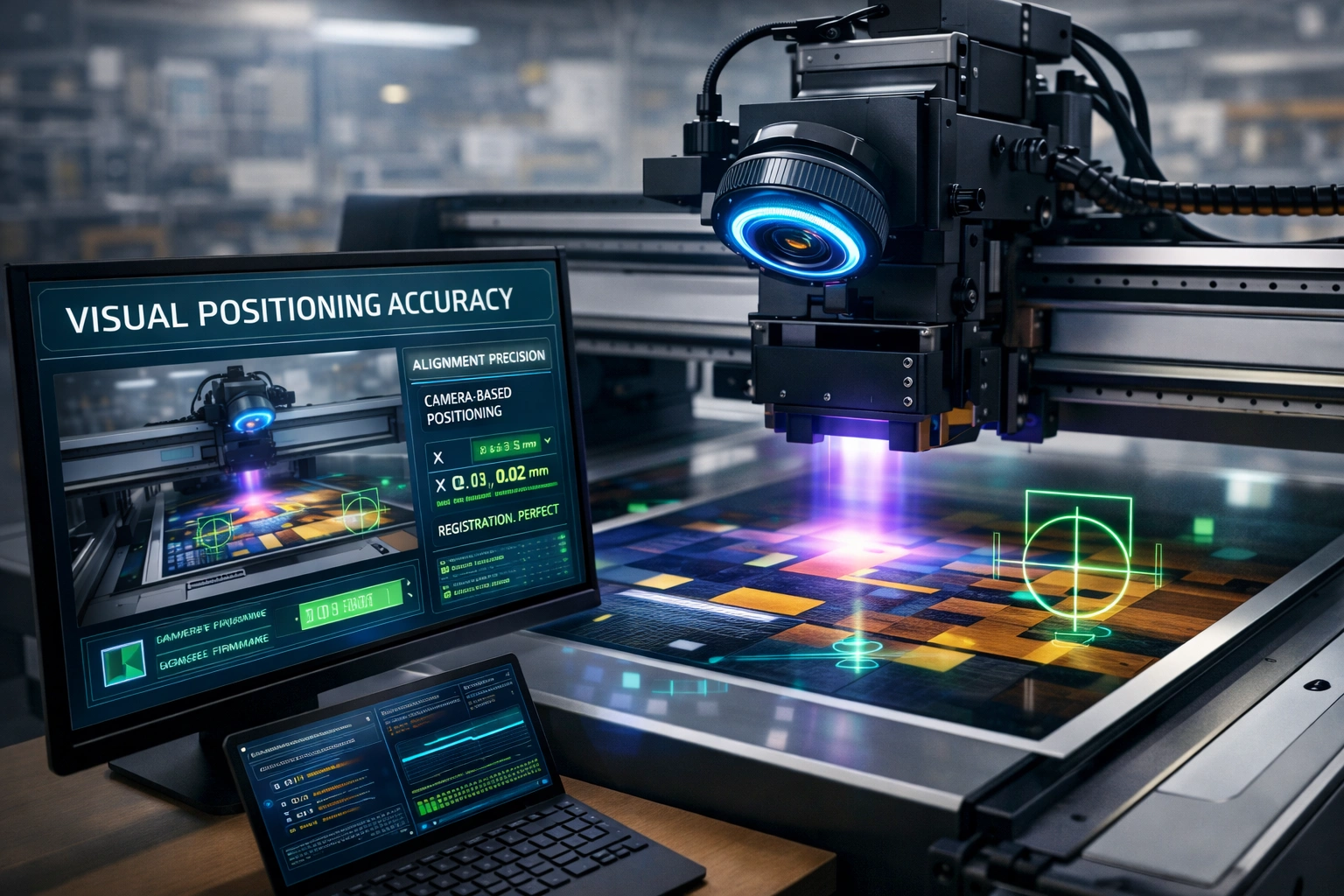
Visual positioning relies on cameras and image recognition algorithms to detect substrates and align prints precisely. Custom firmware allows developers to fine-tune these algorithms based on real-world conditions such as lighting variations, reflective materials, or irregular shapes.
This level of control significantly improves registration accuracy, especially for multi-layer printing or complex designs.
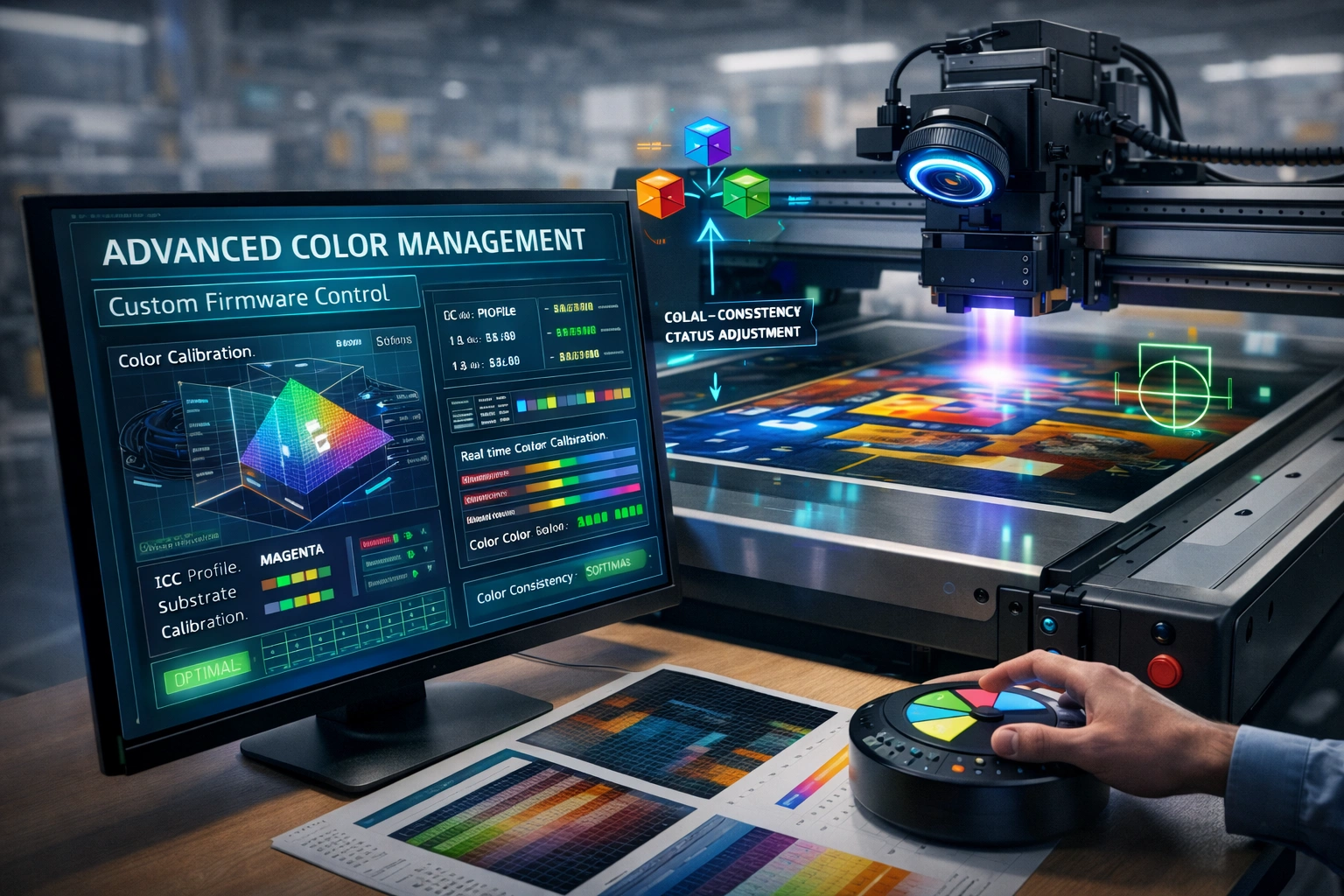
Advanced Color Management
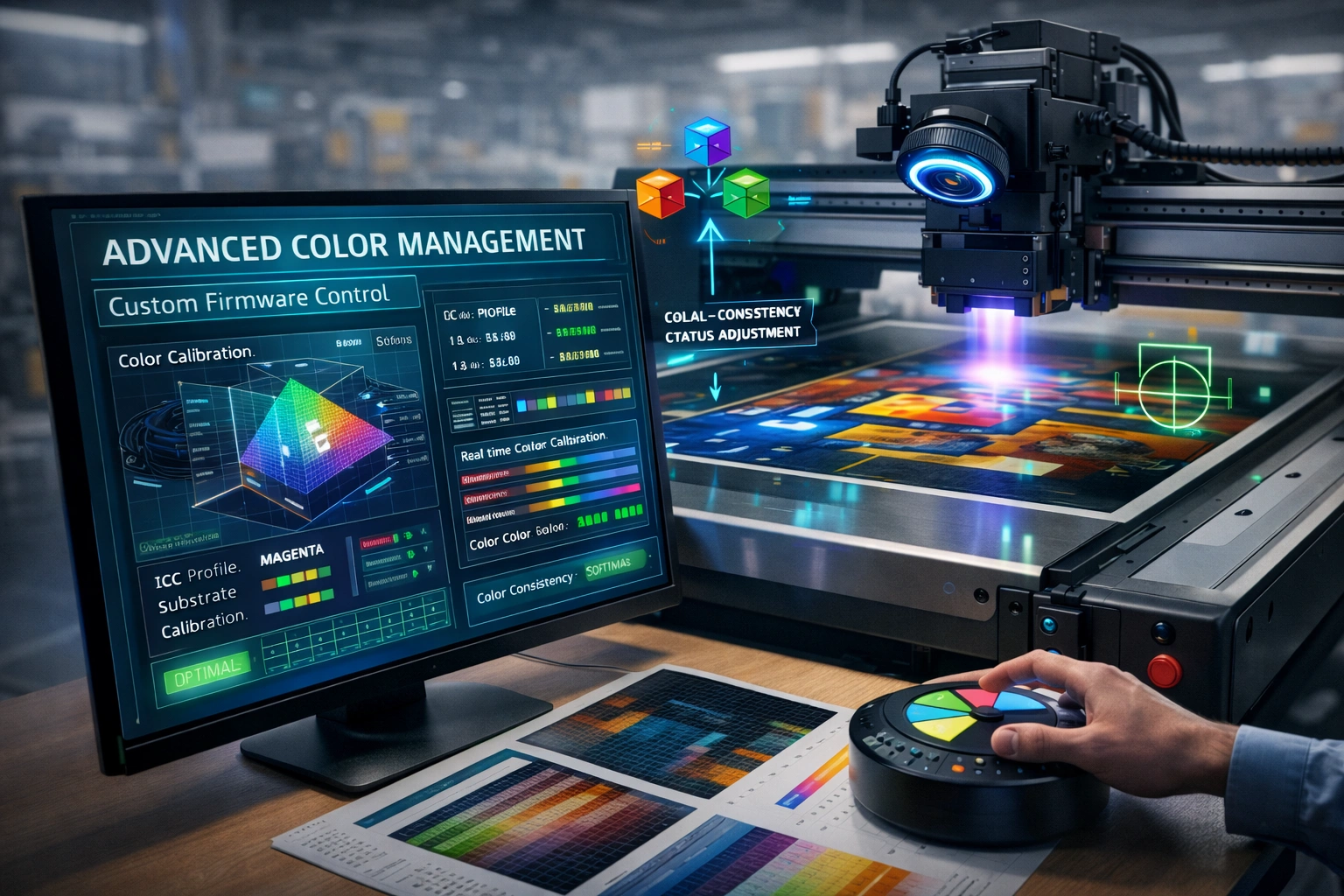
Color consistency is critical in professional printing environments. Custom firmware enables deeper integration of ICC profiles, dynamic color correction, and substrate-specific color calibration.
Operators can achieve consistent color output across different materials, batches, and production runs, reducing reprints and customer complaints.
Workflow Customization
Every printing operation has unique workflow requirements. Custom firmware can automate repetitive tasks, integrate with external software systems, and support customized job queues.
This leads to reduced operator intervention, fewer errors, and smoother production processes.
Better Hardware Integration
Visual Positioning UV printers often work alongside conveyors, robotic arms, curing systems, or inspection cameras. Custom firmware ensures seamless communication between all components, enabling synchronized operation and higher automation levels.
Reduced Downtime and Maintenance Costs
Built-in diagnostics, predictive maintenance alerts, and real-time monitoring features can be integrated into custom firmware. These capabilities help identify potential issues before they cause machine failure, reducing downtime and maintenance expenses.
Scalability and Future Readiness
As production requirements evolve, custom firmware can be updated or expanded without replacing hardware. This flexibility ensures long-term value and allows businesses to adapt to new technologies and market demands.
Core Features of Custom Firmware for Visual Positioning UV Printers
Intelligent Vision Algorithms
Custom firmware enables advanced image processing techniques such as edge detection, pattern recognition, and adaptive thresholding. These features improve substrate detection and alignment accuracy under varying conditions.
Precision Motion Control
Firmware-level optimization of motors, encoders, and rails ensures smoother movement and precise positioning. This is particularly important for high-resolution printing and multi-pass jobs.
Custom User Interfaces
User interfaces can be redesigned to match operator roles and skill levels. Simplified dashboards, visual alerts, and customizable controls improve usability and reduce training time.
Real-Time Error Detection
Custom firmware can monitor print quality, ink flow, UV curing performance, and mechanical stability in real time. Automatic error detection allows immediate corrective action, minimizing waste.
Multi-Material Support
Different materials require different print parameters. Custom firmware allows operators to create and store material-specific profiles, enabling quick switching between jobs.
Secure Access and Permissions
Role-based access control can be implemented to prevent unauthorized changes to critical settings, ensuring consistent quality and operational security.
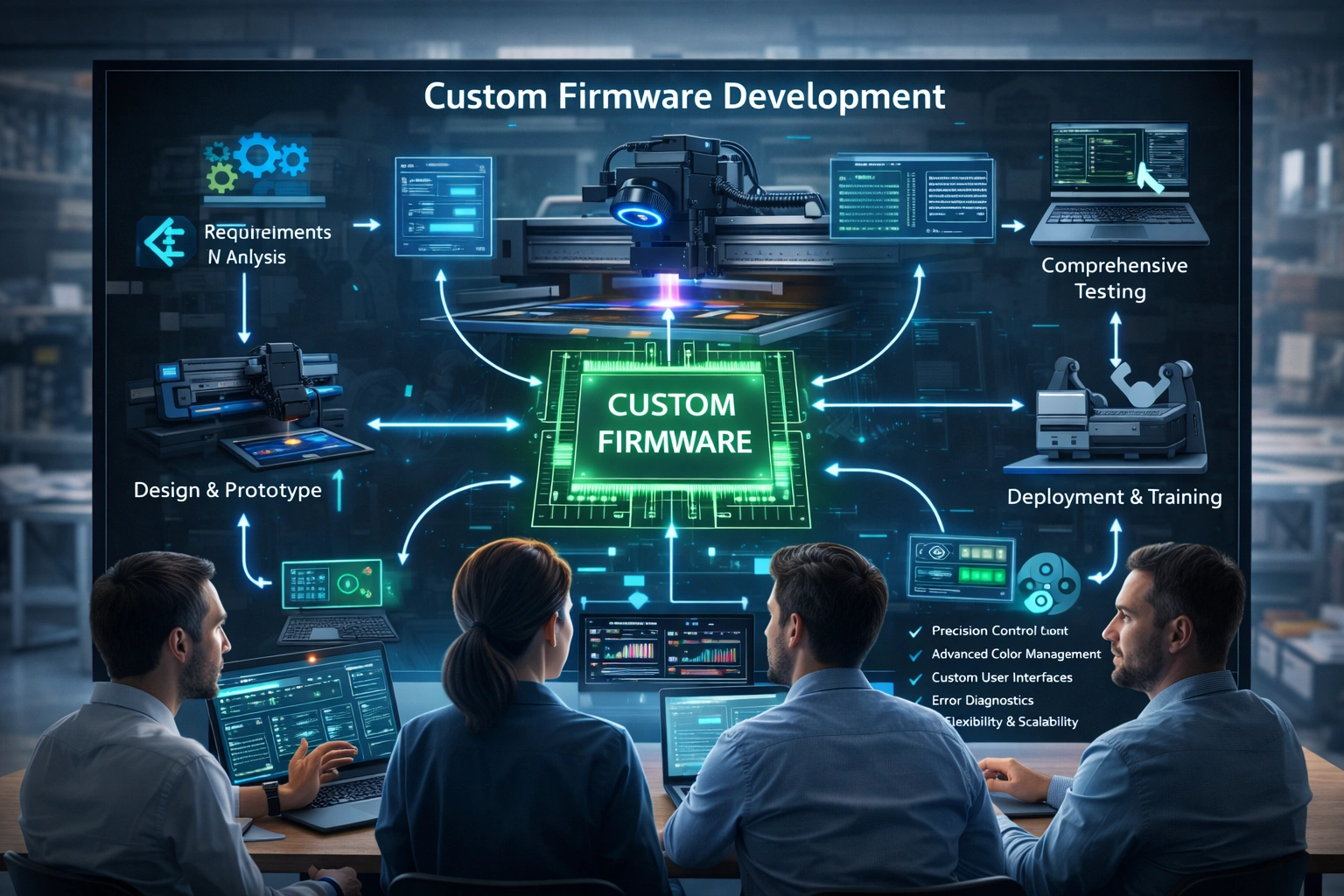
The Custom Firmware Development Process
Requirements Analysis
The process begins with a detailed assessment of current printer performance, production challenges, and business goals. Developers work closely with operators, engineers, and managers to identify improvement opportunities.
System Architecture Design
Based on the requirements, a firmware architecture is designed that defines system modules, communication protocols, and performance benchmarks.
Prototype Development
Initial firmware prototypes are created and tested in controlled environments. This stage focuses on validating core features and identifying potential risks.
Iterative Development and Optimization
Firmware is refined through multiple iterations, with continuous testing and feedback. Performance metrics such as speed, accuracy, and stability are closely monitored.
Comprehensive Testing
Extensive testing ensures compatibility with hardware components, production environments, and real-world workloads. Stress testing and long-duration trials are conducted to verify reliability.
Deployment and Training
Once validated, the firmware is deployed to production machines. Operators receive training to ensure smooth adoption and effective use of new features.
Ongoing Support and Updates
Custom firmware requires ongoing maintenance to address evolving needs, security updates, and performance enhancements.
Real-World Applications and Use Cases
Industrial Packaging Production
Packaging manufacturers often handle high volumes and tight tolerances. Custom firmware improves alignment accuracy and speed, enabling consistent quality at scale.
Personalized Product Printing
Customization requires precise placement on varied substrates. Custom firmware enables accurate detection and alignment, reducing setup time and waste.
Specialty Surface Printing
Printing on irregular or reflective surfaces is challenging. Custom vision algorithms improve detection and alignment in these complex scenarios.
Automated Manufacturing Lines
Custom firmware integrates Visual Positioning UV printers into fully automated production lines, enabling synchronized operation with minimal human intervention.
Challenges in Custom Firmware Development
Despite its benefits, custom firmware development presents challenges such as hardware compatibility, development costs, and the need for skilled engineers. Careful planning and collaboration with experienced developers are essential to mitigate risks.
Security and Stability Considerations
Custom firmware must be designed with robust security measures to prevent unauthorized access and ensure data integrity. Thorough testing and version control are critical for long-term stability.
Future Trends in Custom Firmware for UV Printing
Emerging trends include AI-powered vision systems, cloud-based monitoring, predictive maintenance, and deeper integration with Industry 4.0 platforms. Custom firmware will play a central role in enabling these innovations.
Conclusion
Custom firmware development is a powerful strategy for maximizing the performance, flexibility, and longevity of Visual Positioning UV printers. By tailoring software to specific operational needs, businesses can achieve superior print quality, higher efficiency, and greater adaptability in a competitive market.
As printing technology continues to evolve, custom firmware will remain a key differentiator for organizations seeking long-term success and innovation in digital printing.
For those interested in enhancing their UV printing capabilities, explore our high-quality Visual Positioning UV printers here.
Frequently Asked Questions (FAQ)
What is custom firmware in UV printers?
Custom firmware is specialized software designed to optimize printer performance, workflows, and features based on specific requirements.
Is custom firmware safe for existing printers?
Yes, when developed and tested correctly, custom firmware is safe and often improves stability and performance.
Can custom firmware improve print accuracy?
Absolutely. It allows fine-tuning of vision systems, motion control, and color processing.
How long does development usually take?
Depending on complexity, development can take several weeks to a few months.
Does custom firmware support future upgrades?
Yes, it is designed for scalability and long-term adaptability.