

 HOME
HOME PRODUCT CENTER
 ABOUT US
 DOWNLOAD CENTER
 SUPPORT CENTER
 SUBSCRIBE
 BLOG
BLOGVisual Positioning UV Printer Software Licensing Explained
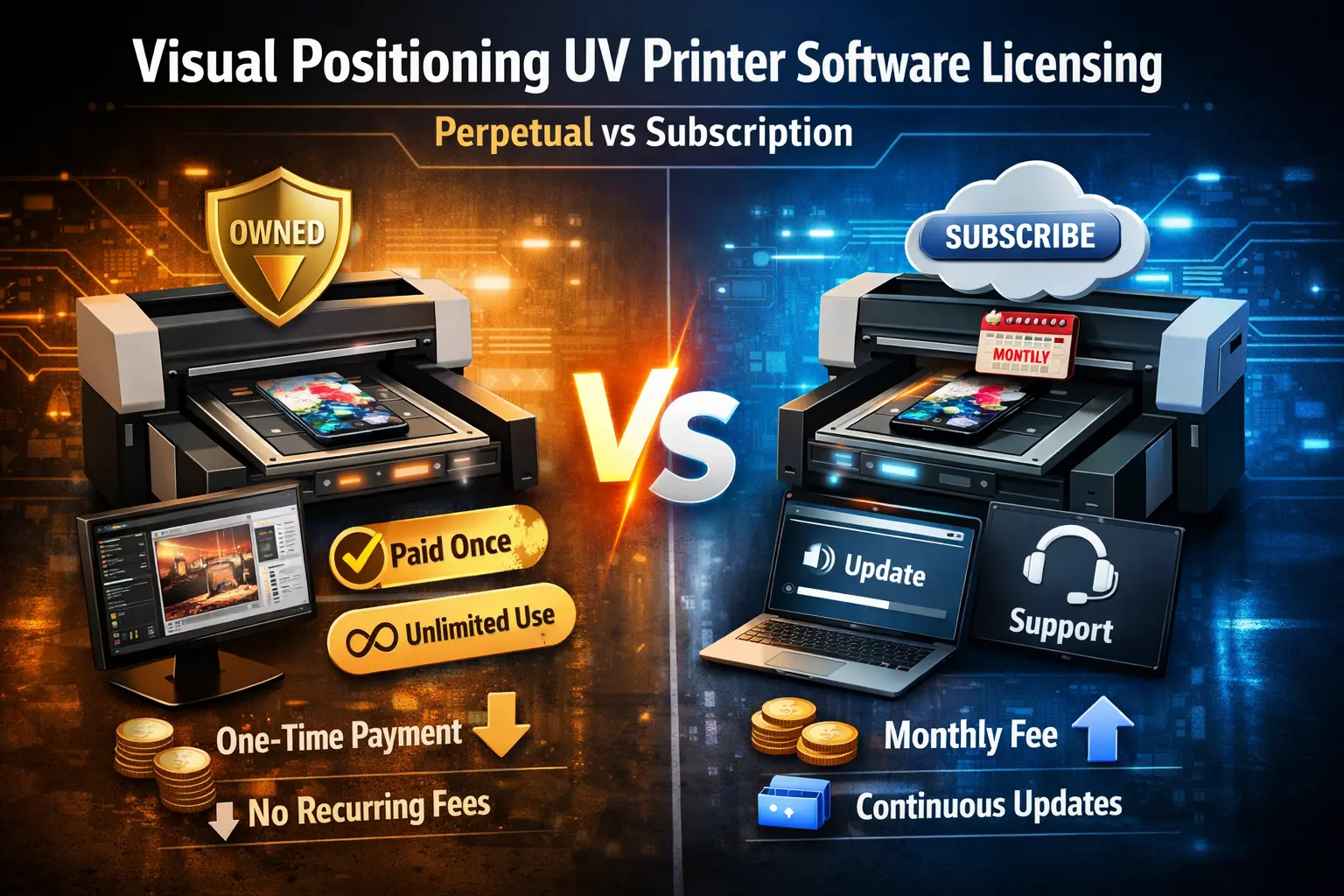
The rapid advancement of digital printing technology has transformed how manufacturers, branding agencies, and print service providers operate. Among these innovations, visual positioning UV printers have carved out a strong position due to their unmatched accuracy, material flexibility, and automation capabilities. These machines are widely used for printing on irregular objects, customized products, industrial components, and high-precision decorative applications.
However, while businesses often focus heavily on hardware specifications—such as print heads, curing lamps, or ink types—software licensing is an equally critical decision that directly impacts long-term costs, workflow stability, scalability, and operational freedom.
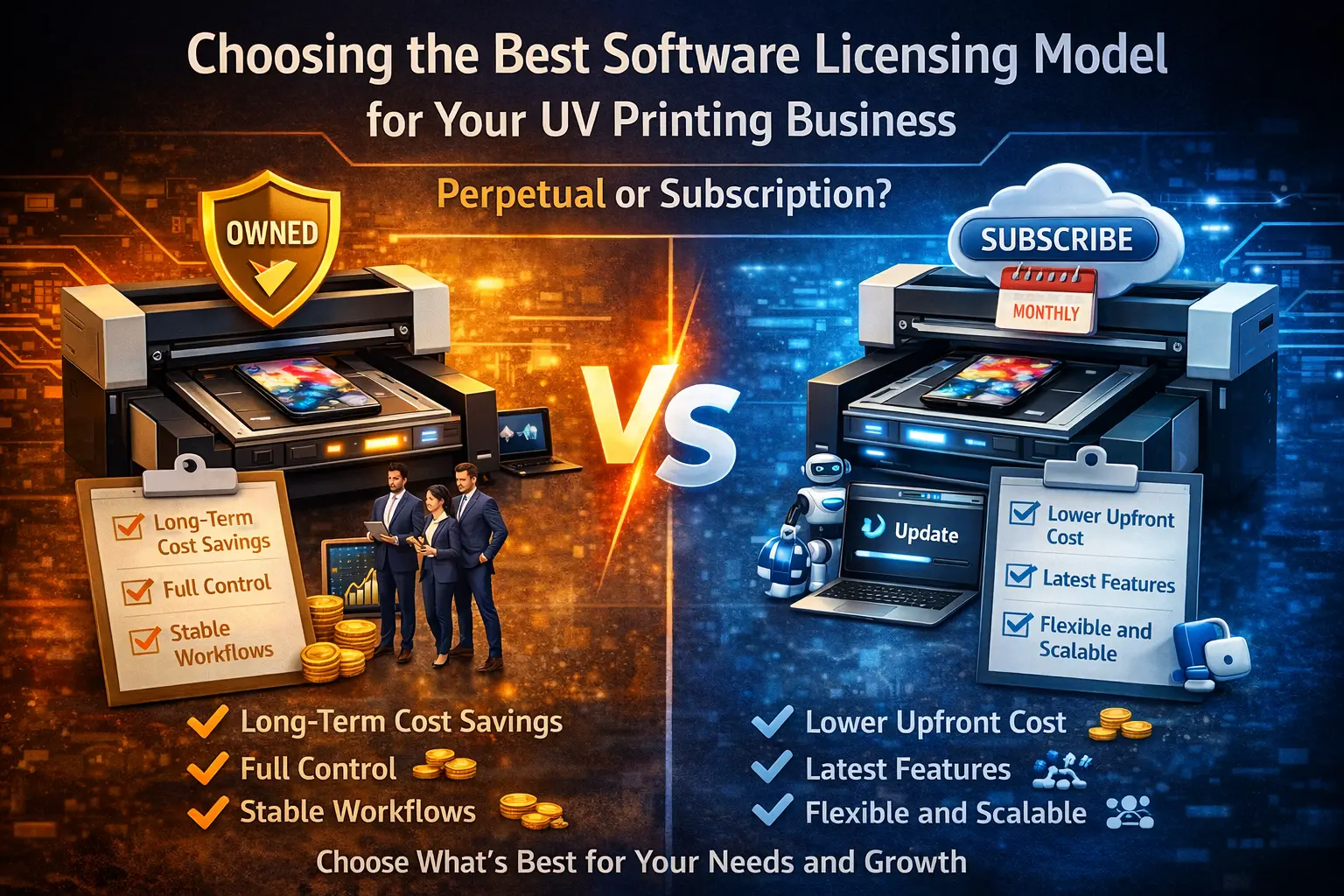
One of the most common dilemmas faced by buyers today is choosing between perpetual software licensing and subscription-based licensing for visual positioning UV printer software. Both models serve different business philosophies, financial strategies, and growth stages.
This in-depth guide explains both licensing models in detail, compares their advantages and drawbacks, and helps you decide which option aligns best with your printing business—without bias, marketing hype, or technical confusion.
Understanding Visual Positioning UV Printer Software
Before diving into licensing models, it is essential to understand what visual positioning UV printer software actually does and why it plays such a vital role.
Visual positioning software uses industrial cameras, AI-based recognition, and coordinate mapping to detect the exact position, angle, and orientation of objects placed on the printer bed. Instead of relying on manual alignment or fixed jigs, the software automatically adjusts the print layout to match the real-time placement of each object.
Core Functions of Visual Positioning Software
Object detection and contour recognition
Automatic image alignment and distortion correction
Batch processing of irregular or mixed objects
Precision printing without physical molds or fixtures
Integration with RIP software and printer controllers
Because this software controls accuracy, speed, and error reduction, its licensing model directly affects how freely you can use, upgrade, and scale your production.
Overview of Software Licensing Models
In the UV printing ecosystem, software licensing generally falls into two main categories:
Perpetual Licensing
Subscription Licensing
Each model defines how you pay for the software, how long you can use it, and what kind of updates and support you receive.
What Is Perpetual Software Licensing?
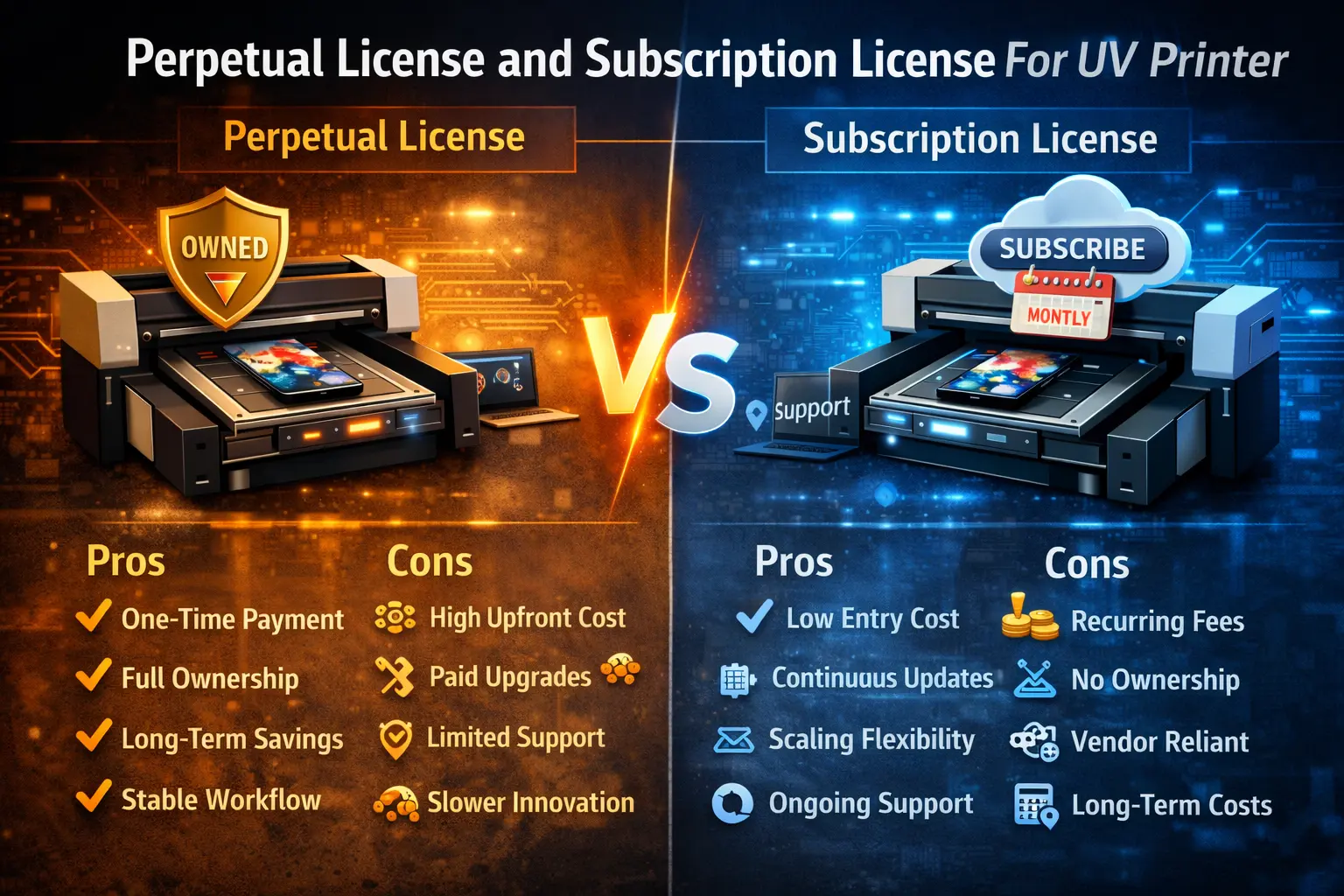
A perpetual license allows you to purchase the software once and use it indefinitely. After paying a one-time fee, the software remains functional without any mandatory recurring payments.
You are not renting the software—you own the license.
How Perpetual Licensing Works
One-time upfront payment
Software can be used for unlimited time
Core features remain permanently available
Updates and upgrades may require additional payment
Support may be time-limited unless extended
This model has been widely used in industrial printing environments for decades, especially where stability and predictability are more important than frequent feature changes.
Advantages of Perpetual Licensing
1. One-Time Investment, No Recurring Fees
The biggest advantage of perpetual licensing is cost certainty. Once purchased, there are no monthly or annual payments, making it easier to forecast long-term expenses.
For businesses operating on tight margins or fixed contracts, this eliminates ongoing financial pressure.
2. Full Ownership and Operational Independence
With a perpetual license, the software does not stop working if payments stop. Your production remains uninterrupted even if:
Internet access is limited
The vendor changes pricing policies
The software provider exits the market
This independence is especially valuable for factories and print shops running 24/7 operations.
3. Long-Term Cost Efficiency
While the upfront cost may be higher, perpetual licensing often becomes more economical over time. Businesses using the same software for five, seven, or even ten years usually pay far less compared to cumulative subscription fees.
4. Stable and Predictable Workflows
Perpetual licenses typically use stable software versions. Since updates are optional, your workflow remains consistent, reducing risks associated with sudden interface changes or feature removals.
5. Greater Customization Flexibility
Many perpetual licenses allow deeper system-level customization, third-party integrations, and tailored workflows—especially important for specialized or industrial printing applications.
Limitations of Perpetual Licensing
1. High Initial Cost
The upfront purchase price can be substantial, particularly for advanced visual positioning systems. This may be challenging for startups or small businesses with limited capital.
2. Paid Upgrades and Feature Access
While you own the software, major upgrades are often paid separately. Over time, staying current may still require additional investment.
3. Limited Included Support
Technical support is often provided for a fixed period after purchase. Continued support, training, or troubleshooting may require annual maintenance contracts.
4. Slower Innovation Adoption
Businesses using perpetual licenses may lag behind newer features, AI improvements, or compatibility updates unless they actively purchase upgrades.
What Is Subscription Software Licensing?
Subscription licensing follows a pay-as-you-use model, where access to the software is granted as long as periodic payments are made.
Instead of ownership, you are essentially renting the software.
How Subscription Licensing Works
Monthly or annual recurring payments
Continuous access to latest versions
Automatic updates and patches
Support typically included
Access ends if subscription expires
This model has gained popularity due to cloud computing, SaaS platforms, and rapidly evolving software ecosystems.
Advantages of Subscription Licensing
1. Lower Entry Cost
Subscription models reduce the financial barrier to entry. Businesses can start using advanced visual positioning software without a large upfront investment.
This is particularly beneficial for:
Startups
Pilot projects
Seasonal businesses
2. Always Up-to-Date Software
Subscribers automatically receive:
New features
Performance improvements
Bug fixes
Security updates
This ensures the software remains compatible with evolving hardware and operating systems.
3. Built-In Technical Support
Most subscription plans include ongoing support, updates, and sometimes even remote diagnostics—reducing downtime and maintenance stress.
4. Scalability and Flexibility
Subscription licenses can often be scaled up or down. Businesses can add or remove licenses based on workload, production volume, or staffing needs.
5. Faster Adoption of New Technologies
AI improvements, vision algorithms, and automation features are delivered faster through subscription models, keeping businesses technologically competitive.
Drawbacks of Subscription Licensing
1. Ongoing Financial Commitment
Over time, subscription fees can exceed the cost of a perpetual license—especially for businesses with stable, long-term operations.
2. No Ownership
Once the subscription ends, access to the software is revoked. This can disrupt production and create dependency on the vendor.
3. Vendor Lock-In
Switching software providers can be more difficult due to proprietary formats, cloud dependency, and licensing restrictions.
4. Internet and Server Dependency
Some subscription software requires periodic online verification, which may not be ideal for factories with limited connectivity.
Key Factors to Consider Before Choosing a License
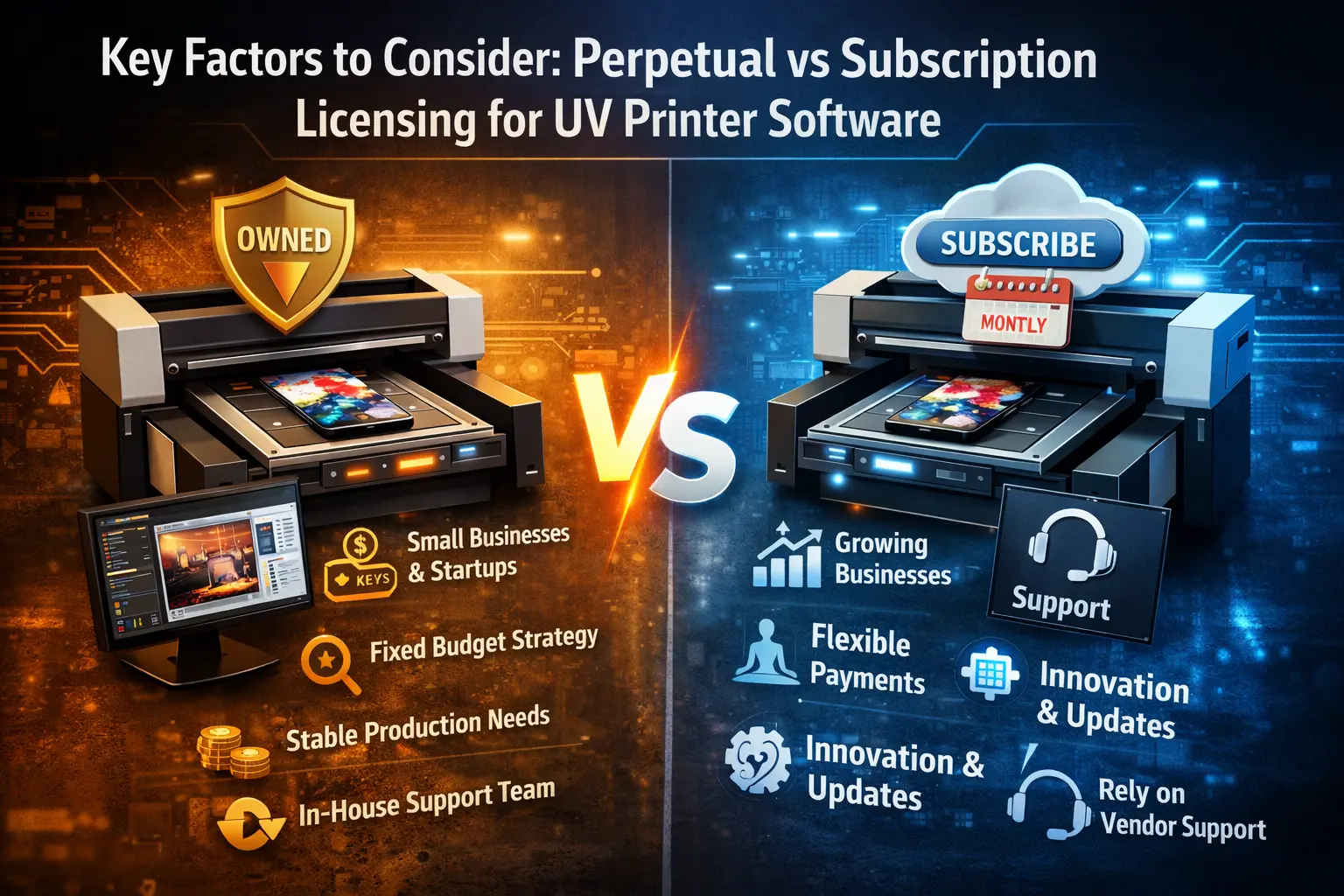
1. Business Size and Growth Stage
Startups → Subscription
Established manufacturers → Perpetual
2. Budget Strategy
Fixed long-term budgeting → Perpetual
Flexible cash flow → Subscription
3. Production Stability
Consistent, repeat workflows → Perpetual
Frequently changing jobs → Subscription
4. Need for Innovation
Stable features acceptable → Perpetual
Cutting-edge tools required → Subscription
5. Support Expectations
In-house technical team → Perpetual
Vendor-dependent support → Subscription
Which Licensing Model Is Best for Your Business?
For Small Print Shops and Startups
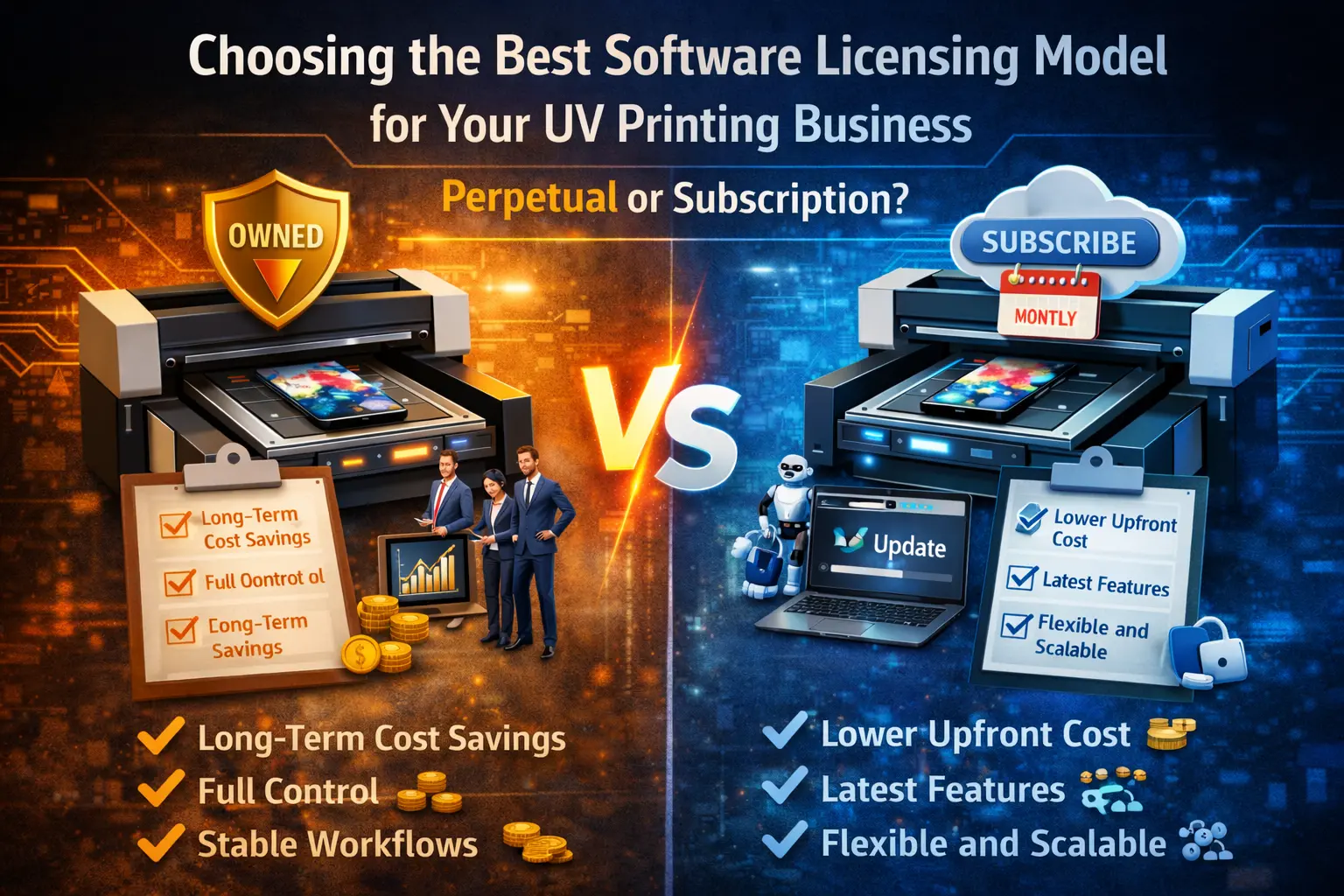
Subscription licensing is usually the better choice due to:
Lower upfront investment
Continuous support
Easier scaling
For Medium to Large Manufacturing Units
Perpetual licensing often delivers better value through:
Long-term cost savings
Production independence
Stable workflows
For Technology-Driven Print Businesses
Subscription licensing helps businesses that prioritize:
AI-based automation
Frequent updates
Integration with evolving systems
Long-Term Strategic Impact
Choosing the right licensing model is not just a financial decision—it shapes your operational freedom, risk exposure, and technology roadmap.
A mismatch between licensing model and business strategy can result in:
Unexpected costs
Production interruptions
Limited scalability
Therefore, decision-makers should evaluate licensing alongside hardware investment, workforce skills, and long-term growth plans.
Conclusion
Visual positioning UV printer software is the backbone of precision printing, automation, and efficiency. Whether you choose a perpetual license or a subscription model, the right decision depends on how your business operates today—and where it plans to go tomorrow.
Perpetual licensing offers stability, ownership, and long-term cost efficiency, making it ideal for established businesses with predictable workflows. Subscription licensing provides flexibility, innovation, and lower entry costs, making it attractive for growing and technology-focused operations.
By understanding the strengths and limitations of each model, you can confidently invest in a licensing strategy that supports sustainable growth, operational reliability, and competitive advantage.
Frequently Asked Questions (FAQ)
What is visual positioning UV printer software?
It is software that uses camera systems and intelligent algorithms to automatically align prints on irregular or randomly placed objects.
Which licensing model is cheaper long term?
Perpetual licensing is usually cheaper for long-term use, while subscription licensing suits short-term or rapidly changing needs.
Can businesses switch licensing models later?
This depends on the software provider’s policy. Some allow migration; others require repurchase.
Does subscription software require the internet?
Some do, especially cloud-based systems. Others allow limited offline operation.
Is perpetual software outdated?
No. Many industrial environments prefer stable versions over frequent updates.