

 HOME
 PRODUCT CENTER
 ABOUT US
 DOWNLOAD CENTER
 SUPPORT CENTER
 SUBSCRIBE
 BLOG
To test UV print durability on stone and slate, evaluate adhesion, abrasion, water resistance, cleaning resistance and, where relevant, outdoor weathering. Use representative production samples, define acceptance criteria before testing, and record both visible damage and the layer where failure occurs.
A print that looks sharp when it leaves the printer may still peel after cleaning, wear away during handling or separate when moisture enters beneath a coating. Stone introduces additional variables: surface texture, porosity, existing sealers and weak mineral layers can all affect the result.
For manufacturers producing slate coasters, decorative plaques, stone signs or personalised gifts, the objective is to qualify the complete product. That includes the stone, preparation, primer, white ink, colour ink and any protective finish—not simply the printer or ink in isolation.
How Should You Prepare Stone and Slate Samples for Durability Testing?
Durability sample preparation creates a repeatable starting point so that differences in test results reflect the printing process rather than uncontrolled changes in the substrate.
Identify the Stone and Its Surface Finish
Record the stone type, supplier, batch and finish. Natural cleft slate, honed slate, polished granite and resin-coated stone should be treated as different printing surfaces.
Inspect for dust, loose particles, moisture, oils, waxes and existing sealers. On slate, a detached mineral flake can carry the printed image away even when the ink remains firmly attached to that flake. This is a substrate failure and requires a different response from poor ink adhesion.
Use a cleaning method compatible with the stone and any coating. Allow samples to reach the defined dry condition before printing, and record how that condition was established.
Test the Complete Production Configuration
Prepare samples using the intended production settings, including primer application, white underbase, colour layers, varnish or protective coating, and curing conditions.
MTuTech's rigid-substrate UV printing solutions provide an equipment starting point for direct printing applications. However, the final stone-and-ink combination must be qualified through testing.
If comparing preparation methods, change one variable at a time. For example, compare the existing process with a supplier-approved primer while keeping the stone batch, artwork and printing settings consistent. Then evaluate a protective finish separately.
Include Controls and Repeated Samples
Keep an unprinted stone sample to identify natural staining, mineral loss or cleaner damage. Retain an unexposed printed sample for appearance comparison, and include a known-performing printed reference where available.
Use separate specimens for destructive tests. A sample damaged by a cross-cut test should not subsequently represent an undamaged product in a water-resistance evaluation.
Allow the conditioning period specified by the ink, primer and coating suppliers before testing. Immediate handling readiness does not automatically establish final adhesion or chemical resistance.
Which Tests Measure UV Print Durability on Stone and Slate?
UV print durability tests expose the printed system to defined stresses and evaluate whether its appearance, adhesion and function remain acceptable.
Different tests answer different questions. Passing a dry adhesion check does not demonstrate resistance to repeated washing, and a successful water test does not prove outdoor colour stability.
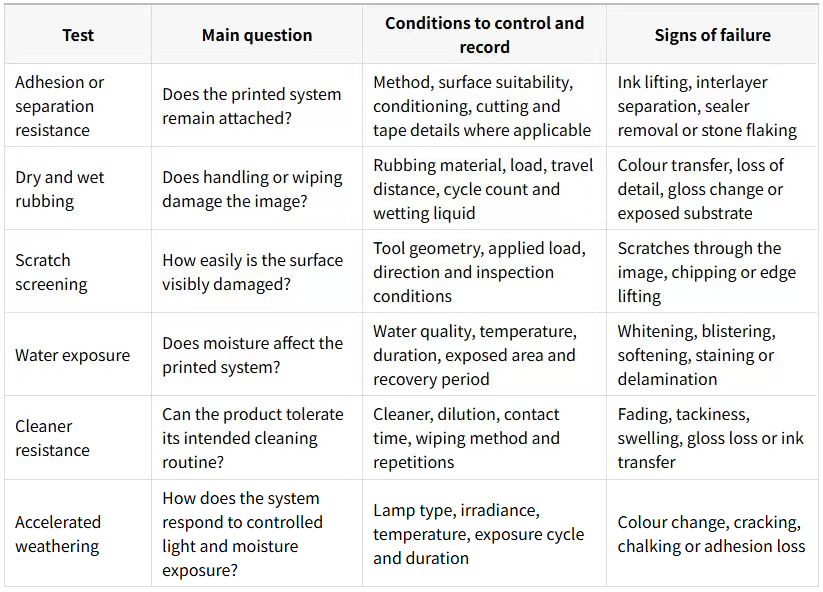
Assess Adhesion Without Misreading Stone Failure
For sufficiently smooth and suitable printed surfaces, a cross-cut method may help assess resistance to coating separation. It is not automatically appropriate for every slate product.
ISO 2409:2020 cross-cut testing describes a lattice-cut assessment and allows a six-step classification where appropriate. It is not a direct measurement of adhesion strength and is unsuitable for textured coatings or coating systems thicker than 250 μm.
Rough, cleft or friable slate can make cutting and interpretation unreliable. Ask a testing laboratory to select an appropriate method rather than forcing a standard cross-cut rating onto an unsuitable surface.
Inspect detached material closely. Determine whether separation occurred between ink and stone, between printed layers, beneath a sealer, or within the stone itself. Photographs of both the damaged area and removed material help identify the failure mechanism.
Evaluate Abrasion and Scratching Separately
Rubbing evaluates repeated contact, while scratching examines damage from a more concentrated contact point. Both can matter for products such as coasters, tabletop items and handled plaques.
For an internal rubbing screen, define a fixed cloth or pad, applied load, stroke length and number of cycles. One back-and-forth movement can be defined as one double rub, provided that definition is used consistently.
A fingernail or coin scratch may reveal an obvious weakness, but it is not a reproducible basis for comparing suppliers. Use a controlled fixture or laboratory method when results will support a purchasing specification.
Inspect fine text, dark solids, white areas and transitions between printed and unprinted regions. These can reveal different forms of wear.
Test Water Exposure and Cleaning Conditions
Select water exposure that reflects the product’s intended use. Condensation beneath a drinking glass, occasional wiping and continuous immersion are different conditions.
ASTM D870 water-immersion testing provides a framework for controlled exposure of coatings to distilled or demineralised water. It does not supply a universal exposure duration or acceptance criterion for printed stone; these must be defined for the application.
For porous stone, decide whether the edges and back remain exposed or are sealed. This choice affects moisture entry and must match the product or the stated purpose of the test. Compare the printed sample with an unprinted control to distinguish ink damage from natural stone darkening.
Evaluate samples after exposure and again after a defined recovery period. Record temporary changes as well as permanent damage.
Test cleaning chemicals separately using the intended dilution, contact time and wiping procedure. Do not assume resistance to plain water establishes resistance to alcohol, detergent or disinfectant.
Add Weathering Tests for Outdoor Products
Outdoor signs and plaques require evidence beyond indoor rubbing and water checks.
ASTM G154 fluorescent UV exposure testing provides procedures for controlled light and moisture exposure. The practice recommends at least three replicate specimens per material and known-performance controls. Results must include the operating conditions; the standard alone does not define a universal pass result.
Specify the exposure cycle and evaluate colour, cracking, surface condition and adhesion at agreed intervals. Do not convert a chamber exposure time directly into a guaranteed number of outdoor years without supporting correlation.
For demanding exterior applications, discuss additional conditions such as temperature cycling or freezing with the laboratory. Accelerated UV exposure alone does not evaluate every environmental stress.
How Do You Interpret Results and Approve a Production Process?
Durability approval compares documented test results with application-specific requirements and identifies whether the complete printed product is suitable for its intended service.
Define Acceptance Criteria Before Testing
Avoid a vague requirement such as “the print must be durable.” Define what the customer needs the product to retain.
For a decorative plaque, the priority may be legible text and stable appearance after routine wiping. A coaster may additionally need resistance to condensation and repeated cleaning. An outdoor sign requires an exposure programme relevant to its location and expected service.
Agree on the allowed changes, inspection conditions and handling procedure before viewing the results. A useful specification states the test, exposure conditions, evaluation method and acceptance limit together.
If colour measurements are required, use the same instrument settings and measurement locations before and after exposure. Natural stone variation and texture can affect readings, so record the measurement geometry and sampling approach.
Diagnose the Failure Before Changing Settings
Peeling is not always solved by increasing curing power or adding more primer.
If a sealer separates from the stone, improving the ink-to-sealer bond will not fix the weakest interface. If slate flakes away, additional ink adhesion may simply pull away more mineral material. If colour remains intact but the protective coating turns cloudy, investigate that coating and its exposure compatibility.
Compare preparation, curing and coating changes systematically. Avoid changing several settings simultaneously, because an improved result will otherwise be difficult to explain or reproduce.
Keep a Traceable Test Report
A practical report should connect every result to a reproducible production configuration:
· Stone identification, finish, supplier and batch.
· Cleaning, drying, primer and coating procedures.
· Printer, ink set, layer order, print mode and curing settings.
· Conditioning time, test conditions and sample identification.
· Before-and-after photographs, measurements, failure location and approval decision.
When comparing MTuTech's UV flatbed printer range, also evaluate how the equipment handles the actual stone. Flatness, thickness variation, positioning and printhead clearance affect whether the qualified process can be repeated in production.
Retest after meaningful changes to the stone supplier, sealer, primer, ink or protective finish. Production checks should verify that the approved process remains under control.
Conclusion
Testing UV print durability on stone and slate means verifying that the complete printed system survives the stresses expected in its intended application.
Start with representative samples and controlled preparation. Assess adhesion, rubbing, water and cleaning resistance separately, and add weathering evaluation for exterior products. Interpret failures at the correct interface and approve the process against requirements agreed before testing.
To discuss a stone-printing application, contact MTuTech with your substrate and durability requirements. Provide sample material, surface-finish details, artwork, intended use and required test conditions so equipment and process recommendations can be evaluated against the actual product.
Frequently Asked Questions
These UV print durability FAQs address common decisions about testing, preparation and performance claims for stone and slate products.
Can You Use a Tape Test on UV-Printed Slate?
A tape test can provide useful screening information, but rough or flaky slate can produce misleading results. Select a method suitable for the surface and inspect whether the removed material is ink, coating or stone. Do not report a formal standard rating unless the procedure and specimen meet its requirements.
How Long Should Samples Condition Before Durability Testing?
Follow the conditioning requirements for the complete ink, primer and coating system. Use the same documented interval for comparable samples. A print that can be handled immediately may not yet have reached its final resistance properties.
Does UV Printing Make Slate Waterproof?
No. UV printing does not automatically waterproof porous stone or seal its edges and back. Water resistance depends on the substrate and the complete coating system, including preparation, curing and any protective finish.
Is a Clear Coat Necessary for Printed Stone?
Not always. A compatible clear coat may improve particular properties, but it can also change gloss, colour or adhesion. Compare coated and uncoated samples under the same test conditions before adding it to the production process.
Can Accelerated UV Testing Predict Outdoor Lifespan?
It can compare performance and reveal failure mechanisms under controlled conditions. It does not provide a universal conversion from exposure hours to outdoor years. Service-life claims require evidence relevant to the material system, environment and exposure conditions.
What Should You Send a Printer Supplier for Sample Evaluation?
Provide representative stone or slate blanks, surface-treatment details, dimensions, thickness variation, artwork and intended use. Include the required cleaning routine, indoor or outdoor exposure, durability tests and acceptance criteria so the sample evaluation addresses your actual production requirements.